
1. Introduction
This specification defines the Aggregator Protocol, an HTTP-based interface that lets a client create and manage Aggregator
Instances and deploy Aggregator Services. Deployment interfaces are described using the Function Ontology (FnO) [FNO];
a service is deployed by referencing a deployment function and providing its input parameters. A deployed Service is a
dcat:DataService that exposes datasets.
Clients start from the Aggregator Server Description at the server base URL to discover the management endpoint, supported management flows, and the server’s service catalog (§ 5 Aggregator Server Metadata). Using the management endpoint, a client creates (or manages) an Aggregator Instance (§ 6 Aggregator Management) and then follows the instance’s Aggregator Description to find the instance’s service collection and service catalog (§ 8.1 Aggregator Description and § 9 Aggregator Service Management).
Management operations are authenticated and authorized unless a specific management flow explicitly allows unauthenticated requests. This protocol integrates with OpenID Connect [OIDC-Core] for identity and uses UMA-style authorization [UMA] for protected resources, scopes, and tickets as described in § 7 Aggregator Security Model (Authentication & Authorization).
Servers MUST support JSON (application/json) where specified and MAY additionally provide semantically annotated RDF
representations (e.g., JSON-LD or Turtle) via HTTP content negotiation. The Aggregator vocabulary (§ 10 Vocabulary) provides
stable IRIs for classes and predicates used throughout the specification.
2. Definitions
This section defines terminology used throughout this specification. Where applicable, terms are aligned with external specifications such as WebID Profiles [WEBID-PROFILE], OpenID Connect (OIDC) [OIDC-Core], OAuth 2.0 [RFC6749], and User-Managed Access (UMA) [UMA].
2.1. Core Roles and Components
-
Client: An application acting on behalf of an end-user to create Aggregator Instances and configure Aggregator Services.
-
Aggregator Server: The server deployment that exposes discovery metadata and a management API used to create and manage Aggregator Instances.
-
Aggregator Instance (or “Aggregator”): A user- or tenant-scoped logical instance created via the management endpoint. An instance exposes an Aggregator Description and an authenticated management API for configuring services.
-
Aggregator Service (or “Service”): A deployed
dcat:DataServiceandprov:SoftwareAgentinside an Aggregator Instance. It serves one or more datasets and links to the FnO deployment function used to create it (see § 9 Aggregator Service Management). -
Service Catalog: A catalog of FnO deployment functions supported by an Aggregator Server or Aggregator Instance (see § 5.3 Server-level Service Catalog and § 8.2 Instance-level Service Catalog).
2.2. Identity, Authorization, and Tokens
-
User (End-user): A person or agent that owns or controls resources and uses a Client to configure an Aggregator deployment.
-
WebID: An HTTP(S) IRI that identifies an agent and can be dereferenced to obtain a WebID Profile document mainly to discover the user’s IdP (defined in [WEBID-PROFILE]).
-
Identity Provider (IdP): An OpenID Connect Provider following the OIDC spec ([OIDC-Core]) that authenticates a user based on it’s userID and issues ID tokens used by this protocol during management and authorization workflows.
-
Authorization Server (AS): An OAuth 2.0 Authorization Server that supports UMA as defined in ([A4DS]) and issues Requesting Party Tokens (RPTs) for protected resources.
-
Resource Server (RS): An HTTP server that hosts protected resources. In UMA terminology, a Resource Server protects resources and interacts with an Authorization Server to obtain UMA tickets and validate RPTs.
-
UMA Ticket: A value returned in a
WWW-Authenticate: UMA ...challenge when a client requests a protected resource without sufficient authorization. The client presents the ticket to the Authorization Server to obtain an RPT. -
Requesting Party Token (RPT): An OAuth 2.0 token issued by an Authorization Server under UMA that encodes permissions/scopes for a protected resource (see [RFC6750]).
-
ID Token: An OpenID Connect ID token representing the authenticated user (and, depending on the deployment, the client). The protocol uses ID tokens as claim tokens in UMA exchanges and during management flows as described in § 7 Aggregator Security Model (Authentication & Authorization).
-
Client ID Document: A dereferenceable client metadata document that follows the OAuth Client ID Metadata Document specification [Client-ID].
2.3. Namespaces
The following namespace prefixes are used throughout this specification and SHOULD appear in RDF serializations (e.g., Turtle, JSON-LD contexts):
-
aggr:→https://w3id.org/aggregator# -
dct:→http://purl.org/dc/terms/ -
fno:→https://w3id.org/function/ontology# -
dcat:→http://www.w3.org/ns/dcat# -
rdf:→http://www.w3.org/1999/02/22-rdf-syntax-ns# -
rdfs:→http://www.w3.org/2000/01/rdf-schema# -
xsd:→http://www.w3.org/2001/XMLSchema# -
prov:→http://www.w3.org/ns/prov#
3. Architecture & Resource Model
This section describes the high-level architecture of an Aggregator deployment and the resource model exposed by this specification. It connects the terminology in § 2 Definitions to the endpoint definitions in later sections.
3.1. Resource Types
This specification defines HTTP resources at three levels:
-
Aggregator Server resources: metadata and instance management (see § 5 Aggregator Server Metadata and § 6 Aggregator Management).
-
Aggregator Instance resources: instance metadata and service management (see § 8 Aggregator Metadata and § 9 Aggregator Service Management).
-
Aggregator Service resources: a service collection and individual services managed under the instance (see § 9.1.2 Service Discovery and the service resource).
To facilitate discovery, all resources MUST expose a hierarchy of HTTP Link headers ([Web-Linking]),
referencing the base URL of each level they belong to:
-
Aggregator Server resources MUST reference the base URL of the Aggregator Server using
aggr:fromServer. -
Aggregator Instance resources MUST reference:
-
the base URL of the Aggregator, using
aggr:fromAggregator; and -
the base URL of the Aggregator Server, using
aggr:fromServer.
-
-
Aggregator Service resources MUST reference:
-
the base URL of the Aggregator Service, using
aggr:fromService; -
the base URL of the Aggregator, using
aggr:fromAggregator; and -
the base URL of the Aggregator Server, using
aggr:fromServer.
-
Each level therefore includes all Link relations required of the levels above it, in addition to its own.
3.2. Addressing and URL Discovery
An implementation MAY use either of the following instance addressing patterns:
-
Host-based instances:
https://{instance-id}.aggregator.example/ -
Path-based instances:
https://aggregator.example/{instance-id}/
Clients SHOULD treat URLs advertised by Aggregator Server and Aggregator Instance metadata as authoritative and SHOULD NOT construct resource URLs by string concatenation unless this specification explicitly fixes the path. Unless a path is explicitly fixed, the concrete URLs shown in this document serve as illustrative defaults; deployments MAY use different locations as long as the relevant metadata resources advertise the authoritative links.
3.3. Security Boundaries
All security requirements are defined in § 7 Aggregator Security Model (Authentication & Authorization). At a high level:
-
Server-level discovery resources: deployments MAY expose the server description (see § 5.1 Aggregator Server Description) and the server-level service catalog (see § 5.3 Server-level Service Catalog) without authentication, or MAY protect them using an OpenID Connect (OIDC) ID Token. The Client ID Document (see § 5.2 Client ID Document) is typically accessible without authentication.
-
Management endpoint: deployments MAY protect the management endpoint (see § 6 Aggregator Management) using OIDC. Some management flows explicitly allow unauthenticated requests; in those cases, the endpoint MAY accept requests without authentication as defined in § 6 Aggregator Management.
-
Instance-level resources: the Aggregator Description (see § 8 Aggregator Metadata) and all resources under the service management API (see § 9 Aggregator Service Management) are protected resources governed by the authentication and authorization mechanisms defined in § 7 Aggregator Security Model (Authentication & Authorization).
The aggregator and its clients SHOULD use secure transport (HTTPS) for all communication, and SHOULD use DPoP wherever
possible to sender-constrain access tokens to the client. Aggregator endpoints intended for browser-based clients MUST
support CORS. Unless the client and Aggregator are tightly coupled and deployed under the same origin, the server MUST
answer OPTIONS preflight requests and include appropriate Access-Control-Allow-* headers for the methods and headers
used by this specification. Implementations MAY restrict allowed origins to trusted client origins.
3.4. Example URL Layout (Non-normative)
This non-normative example illustrates one possible URL layout for the Aggregator Server, an Aggregator Instance, and a Service in a path-based deployment:
-
Server description:
https://aggregator.example/ -
Aggregator Management:
https://aggregator.example/registration -
Client ID Document:
https://aggregator.example/client.jsonld -
Deployment catalog:
https://aggregator.example/deployments -
Instance description:
https://aggregator.example/agg1/ -
Instance Deployment catalog:
https://aggregator.example/agg1/deployments -
Service collection:
https://aggregator.example/agg1/services -
Service description:
https://aggregator.example/agg1/services/service1/ -
Service output:
https://aggregator.example/agg1/services/service1/output
4. Aggregator Data Model
This section specifies the data model used to describe deployment functions, running Aggregator Services, and the datasets those services expose. By describing them as linked data, the model enables interoperable publication, discovery, and deployment of Aggregator Services.
This specification publishes a predefined JSON-LD context at
https://w3id.org/aggregator/contexts/aggregator.jsonld that maps the terms used throughout this data model
(including the aggr: vocabulary defined in § 10 Vocabulary and the external vocabularies it reuses, such as [FNO],
[Data-Catalog], and [PROV-O]). JSON-LD representations of the resources defined in this section MAY
reference this context using @context. Two additional contexts are published for the JSON documents that use
specialized member names: https://w3id.org/aggregator/contexts/aggregator-server-description.jsonld for the
§ 5.1 Aggregator Server Description and https://w3id.org/aggregator/contexts/aggregator-description.jsonld for the
§ 8.1 Aggregator Description.
4.1. Deployment Function
A deployment function defines the interface for deploying an Aggregator Service using the Function Ontology [FNO].
It describes the information a client supplies in an aggr:ServiceRequest; it does not describe the functionality
performed by the resulting service.
Each deployment function:
-
MUST be described as an
fno:Function. -
SHOULD use
dct:descriptionto provide a human-readable description. -
MAY use
fno:nameto provide a short name, but clients SHOULD NOT rely on this property for unique identification. -
MAY describe zero or more
fno:Parameterresources usingfno:expects. -
MUST describe exactly one
fno:Outputusingfno:returns.
Each parameter:
-
MUST be an
fno:Parameter. -
MUST use
fno:predicateto specify the predicate used to provide its value in anaggr:ServiceRequest. -
SHOULD use
fno:typeto describe the parameter type. -
MAY use
dct:formatto describe the parameter format. -
MAY use
dct:conformsToto indicate that the parameter follows a specification or protocol. -
MAY use
fno:requiredto indicate whether the parameter is required or optional. If this property is absent, clients MUST assume the parameter is optional.
The output:
-
MUST be an
fno:Output. -
MUST have
aggr:Serviceas itsfno:type. -
MUST use
fno:predicateto specify the output predicate. -
MAY use
dct:conformsToto further describe the kind of service produced by the deployment function. This specification does not prescribe the referenced description or profile.
dct:conformsTo to describe the profile of a Service is under active development and may be
formalized in a separate specification in the future.
Additional FnO metadata MAY be linked to a deployment function, such as an fno:Implementation using an
fno:Mapping, or the algorithm it implements using fno:Algorithm as specified by [FNO].
@base <http://aggregator.example.org/service-catalog#> . @prefix aggr: <https://w3id.org/aggregator#> . @prefix fno: <https://w3id.org/function/ontology#> . @prefix xsd: <http://www.w3.org/2001/XMLSchema#> . @prefix dct: <http://purl.org/dc/terms/> . <QueryViewDeployment> a fno : Function ; fno : name "The SPARQL QueryView function" ^^ xsd : string ; dct : description "Deploys a service that exposes a materialized SPARQL query view" ^^ xsd : string ; fno : expects ( <QuerySource> <QueryString> ) ; fno : returns ( <ServiceOutput> ) . <QuerySource> a fno : Parameter ; fno : predicate <source> ; fno : type xsd : anyURI ; fno : required "true" ^^ xsd : boolean . <QueryString> a fno : Parameter ; fno : predicate <query> ; fno : type xsd : string ; dct : conformsTo <https://www.w3.org/TR/2013/REC-sparql11-query-20130321/> ; fno : required "true" ^^ xsd : boolean . <ServiceOutput> a fno : Output ; fno : type aggr : Service ; fno : predicate <service> ; dct : conformsTo <https://example.org/profiles/sparql-query-service> .
4.2. Service Catalog
A Service Catalog references all deployment functions made available on an Aggregator Server.
The Service Catalog:
-
MUST be described as an
aggr:ServiceCatalog. -
MUST reference all supported deployment functions using
aggr:hasDeploymentFunction. -
MAY reference a supported algorithm using
aggr:hasAlgorithm. -
MAY reference a supported mapping using
aggr:hasMapping. -
MUST reference all resources not hosted by the Aggregator Server using
rdfs:seeAlso.
@base <http://aggregator.example.org/deployments#> . @prefix aggr: <https://w3id.org/aggregator#> . @prefix dcat: <http://www.w3.org/ns/dcat#> . @prefix dct: <http://purl.org/dc/terms/> . @prefix rdfs: <http://www.w3.org/2000/01/rdf-schema#> . @prefix fno: <https://w3id.org/function/ontology#> . @prefix rdf: <http://www.w3.org/1999/02/22-rdf-syntax-ns#> . @prefix xsd: <http://www.w3.org/2001/XMLSchema#> . @prefix foaf: <http://xmlns.com/foaf/0.1/> <> a aggr : ServiceCatalog ; aggr : hasDeploymentFunction <QueryViewDeployment> , <http://example.org/external/ExternalFunction> ; rdfs : seeAlso <http://example.org/external/ExternalFunction> .
4.3. Service
A deployed aggregator service is the running resource created from a service request and MUST be modelled as:
-
an
aggr:Service -
a
dcat:DataService([Data-Catalog])
Furthermore, the service:
-
MUST link using
aggr:deploymentFunctionto thefno:Functionused to deploy it. -
MUST link using
dcat:servesDatasetto one or more datasets described asdcat:Datasetresources. -
SHOULD declare operational metadata such as status and creation time.
-
SHOULD indicate it adheres to the aggregator protocol using
dct:conformsTo.
Each corresponding dataset:
-
MUST be described as a
dcat:Dataset. -
MAY reference one or more
dcat:Distributionresources usingdcat:distribution.
A dataset that is exposed for consumption MUST reference at least one dcat:Distribution. A dataset that is not
exposed for consumption is not required to have a distribution.
The corresponding distribution MUST be described as a dcat:Distribution, where each distribution:
-
MUST reference the corresponding output endpoint using
dcat:accessURL. -
MUST reference the service via
dcat:accessService. -
SHOULD declare zero or more output formats if relevant using:
-
dcat:mediaTypewhen the format corresponds to an IANA-registered media type. -
dct:formatwhen the format is not an IANA-conformant media type.
-
-
SHOULD declare conformity using
dct:conformsToif defined.
This ensures that consumers can reliably discover and access the latest available aggregated results. Furthermore, Service
descriptions MAY be semantically enriched to provide more detailed information about their outputs and capabilities.
For example, use dct:accrualPeriodicity on the dataset to indicate the frequency of updates,
or describe the service API using the Hydra Core Ontology ([Hydra]).
@base <https://aggregator.example.org/agg1/services/sparql-query-view-service#> . @prefix server-deploy: <https://aggregator.example.org/deployments#> . @prefix aggr: <https://w3id.org/aggregator#> . @prefix dcat: <http://www.w3.org/ns/dcat#> . @prefix prov: <http://www.w3.org/ns/prov#> . @prefix dct: <http://purl.org/dc/terms/> . @prefix xsd: <http://www.w3.org/2001/XMLSchema#> . <> a aggr : Service ; a dcat : DataService ; a prov : SoftwareAgent ; aggr : status "running" ; aggr : createdAt "2024-01-01T12:00:00Z" ^^ xsd : dateTime ; aggr : deploymentFunction server-deploy : QueryViewDeployment ; dct : conformsTo <https://w3id.org/aggregator#> ; dcat : servesDataset <#dataset> . <#dataset> a dcat : Dataset ; dcat : distribution <#distribution-xml> , <#distribution-json> . <#distribution-xml> a dcat : Distribution ; dcat : mediaType <http://www.iana.org/assignments/media-types/application/sparql-results+xml> ; dcat : accessURL <https://aggregator.example.org/agg1/services/sparql-query-view-service/output> ; dcat : accessService <> . <#distribution-json> a dcat : Distribution ; dcat : mediaType <http://www.iana.org/assignments/media-types/application/sparql-results+json> ; dcat : accessURL <https://aggregator.example.org/agg1/services/sparql-query-view-service/output> ; dcat : accessService <> .
4.4. Service Collection
A Service Collection describes the set of services currently exposed by an Aggregator Instance.
The Service Collection:
-
MUST be described as an
aggr:ServiceCollection. -
MUST reference each contained service using
aggr:hasService.
@base <http://aggregator.example.org/agg1/services> . @prefix aggr: <https://w3id.org/aggregator#> . <> a aggr : ServiceCollection ; aggr : hasService <http://aggregator.example.org/agg1/services/sparql-query-view-service> , <http://aggregator.example.org/agg1/services/rml-mapper-service> .
4.5. Provenance Log
An Aggregator Service MAY link to an aggr:ProvenanceLog using aggr:provenanceLog.
A Provenance Log MUST be described as an aggr:ProvenanceLog and MAY reference
prov:Activity resources using aggr:hasActivity. The prov:Activity MUST link back to the service that
it is associated with using prov:wasAssociatedWith.
5. Aggregator Server Metadata
This section describes the endpoints exposed by the Aggregator Server for discovery and metadata retrieval. Except for the Aggregator Server Description at the server base URL, implementations MUST expose the remaining endpoints at deployment-specific URLs; the server description document MUST include absolute URLs for each resource so that clients can discover them.
5.1. Aggregator Server Description
The Aggregator Server Description allows clients to discover the Aggregator Server’s endpoints and capabilities. This
document MUST be available at the server base URL (i.e., {aggregator-server-url}/), MAY be accessible without
authentication or MAY require an OpenID Connect (OIDC) ID Token depending on deployment policy, and MUST provide at least
the following information. Each JSON member is paired with an RDF predicate from § 10 Vocabulary so the document can also
be served as JSON-LD or other RDF formats using content negotiation based on [RFC9110]:
In semantically annotated representations, the Aggregator Server Description MUST state that the described resource has RDF
type aggr:AggregatorServer (§ 10.1.3 aggr:AggregatorServer) (e.g., via @type in JSON-LD or a aggr:AggregatorServer
in Turtle). Clients MAY rely on this type statement when consuming semantic representations.
- management_endpoint (REQUIRED):
-
The value is a string containing the absolute URL of the Aggregator Management Endpoint (§ 6.1 Aggregator Management Endpoint); in the RDF representations, this member maps to the predicate
aggr:managementEndpoint(§ 10.2.18 aggr:managementEndpoint). - supported_management_flows (REQUIRED):
-
The value is a JSON array of strings identifying the supported management flow tokens at
management_endpoint; in the RDF representations, each entry maps to anaggr:supportedManagementFlowtriple (§ 10.2.19 aggr:supportedManagementFlow) whose object is the corresponding flow class IRI.Each member MUST be one of the management flow tokens defined in § 6.1 Aggregator Management Endpoint:
-
"none"(RDF classaggr:NoAuthFlow(§ 10.1.9 aggr:NoAuthFlow)) -
"provision"(RDF classaggr:ProvisionFlow(§ 10.1.10 aggr:ProvisionFlow)) -
"authorization_code"(RDF classaggr:AuthorizationCodeFlow(§ 10.1.11 aggr:AuthorizationCodeFlow)) -
"device_code"(RDF classaggr:DeviceCodeFlow(§ 10.1.12 aggr:DeviceCodeFlow))
- supported_management_request_formats (REQUIRED):
-
The value is a JSON array of strings identifying the supported request formats for the
management_endpoint. Each entry MUST be a media type; in RDF representations, each entry maps to anaggr:managementRequestFormatSupportedtriple (§ 10.2.20 aggr:managementRequestFormatSupported). Servers MUST include eitherapplication/jsonorapplication/x-www-form-urlencodedor both. - version (REQUIRED):
-
The value is a string containing the semantic version ([SEMVER]) of the Aggregator specification that the server adheres to; in the RDF representations, this member maps to the predicate
aggr:specVersion(§ 10.2.21 aggr:specVersion). - client_identifier (REQUIRED):
-
The value is a string containing the absolute URL of the Client ID Document (§ 5.2 Client ID Document); in the RDF representations, this member maps to the predicate
aggr:clientIdentifier(§ 10.2.22 aggr:clientIdentifier). - service_catalog (REQUIRED):
-
The value is a string containing the absolute URL of the server-level Service Catalog (§ 5.3 Server-level Service Catalog); in the RDF representations, this member maps to the predicate
aggr:serviceCatalog(§ 10.2.23 aggr:serviceCatalog).
{ "@context" : "https://w3id.org/aggregator/contexts/aggregator-server-description.jsonld" , "aggregator_server_base_url" : "https://aggregator.example/" , "type" : "AggregatorServer" , "management_endpoint" : "https://aggregator.example/registration" , "supported_management_flows" : [ "provision" , "authorization_code" ], "supported_management_request_formats" : [ "application/json" , "application/x-www-form-urlencoded" ], "version" : "1.0.0" , "client_identifier" : "https://aggregator.example/client.jsonld" , "service_catalog" : "https://aggregator.example/service-catalog" }
5.2. Client ID Document
Endpoint that exposes the Client ID Document of the aggregator used for authorization. Servers MAY host this document at any
URL; the client_identifier property in the Aggregator Server Description MUST contain the authoritative absolute URL. The
Client ID Document MUST conform to the OAuth Client ID Metadata Document specification [Client-ID]. In the case for the
aggregator, the redirect_uris property is OPTIONAL instead of REQUIRED, as multiple clients MAY create an Aggregator on
the same Aggregator Server (depending on the implementation). Adding this property allows an Aggregator Server
implementation to restrict which clients may create aggregators on the server.
5.3. Server-level Service Catalog
The Service Catalog is an RDF document whose base resource, identified by the document’s
own retrieval URL, MUST be described as an aggr:ServiceCatalog (§ 4.2 Service Catalog).
Resources referenced by the Service Catalog MAY either be included directly in the RDF document or
hosted by the Aggregator Server in separate documents.
Aggregator servers MUST publish this catalog, at any deployment-specific URL of their choosing using the GET method.
The URL MUST be advertised in the § 5.1 Aggregator Server Description via the service_catalog field.
The catalog SHOULD support HTTP content negotiation, allowing clients to request different RDF serializations
(e.g., Turtle, JSON-LD).
6. Aggregator Management
This section describes how Aggregator Instances are managed at the Aggregator Server level. Deployments define their own authorization policy for these endpoints, but they MUST require authenticated requests so the Aggregator provider can authorize a user to manage their aggregators. The tokens used in these requests (IDP_client_token) prove the identity of
the user and the client (Client ID Document) used to access the Aggregator Server. Deployments MAY expose the same
functionality at different paths, provided that the Aggregator Server Description advertises the authoritative URLs.
6.1. Aggregator Management Endpoint
This section specifies the behavior of themanagement_endpoint advertised by the Aggregator Server Description
(§ 5.1 Aggregator Server Description). The endpoint supports creating Aggregator Instances, replacing the stored token set for an
existing instance, and deleting an instance. If the management_flow isn’t none the endpoint SHOULD reject
unauthenticated requests with 401 Unauthorized.
For error conditions, the server MUST respond with:
-
400 Bad Requestfor a malformed request body or missing/invalid request members for the selectedmanagement_flow. -
401 Unauthorizedwhen the request is missing authentication or when theIDP_client_tokenis invalid. -
403 Forbiddenwhen the authenticated user is not allowed to manage the requested Aggregator Instance. -
404 Not Foundwhenaggregatoris provided but does not identify an existing Aggregator Instance. A403 ForbiddenMAY also be returned in this case. -
415 Unsupported Media Typewhen the request format is not listed insupported_management_request_formats.
6.1.1. POST
Creates an Aggregator Instance or replaces the stored token set for an existing instance.
The request body MUST use a content type listed in supported_management_request_formats. When using application/json,
the body MUST be a JSON object. When using application/x-www-form-urlencoded, the body parameters MUST be encoded as
form fields with the same member names. The request body MUST include the following members:
-
management_flow (REQUIRED): The value is a string token; it MUST be one of the
supported_management_flowsadvertised in the Aggregator Server Description (§ 5.1 Aggregator Server Description). The following string tokens are defined, each corresponding to an RDF class in the Aggregator vocabulary (§ 10 Vocabulary) for semantically annotated representations:-
"none"↔aggr:NoAuthFlow(§ 10.1.9 aggr:NoAuthFlow) -
"provision"↔aggr:ProvisionFlow(§ 10.1.10 aggr:ProvisionFlow) -
"authorization_code"↔aggr:AuthorizationCodeFlow(§ 10.1.11 aggr:AuthorizationCodeFlow) -
"device_code"↔aggr:DeviceCodeFlow(§ 10.1.12 aggr:DeviceCodeFlow)
-
-
aggregator (string, OPTIONAL): When present, the request targets an existing Aggregator Instance and the server MUST replace its stored access token and refresh token with a new set obtained from the Identity Provider (IdP). This is not a refresh-token grant; it is a full re-authentication to obtain a fresh access token and refresh token.
-
authorization_server (string, OPTIONAL): The URL of the UMA Authorization Server that governs access to resources exposed by the Aggregator.
Depending on management_flow, additional members are defined:
-
management_flow: "none"
-
No additional members are required.
In this flow the Aggregator Instance has no identity and all requests to upstream resource servers will be unauthenticated. In this flow the management POST request MIGHT not require authentication, depending on the deployment’s policy.
-
-
management_flow: "provision"
-
No additional members are required.
In this flow the Aggregator server MUST provision an new identity for the Aggregator Instance that is registered at an Identity Provider (IdP).
-
-
management_flow: "authorization_code" The
authorization_codeflow uses twoPOSTmessages to themanagement_endpoint. It is based on the OAuth 2.0 Authorization Code grant [RFC6749] (https://datatracker.ietf.org/doc/html/rfc6749). The Start Request bootstraps PKCE [RFC7636], the request body MUST include:-
management_flow (string, REQUIRED):
"authorization_code".
The server MUST respond with
201 Createdand a JSON object containing:-
aggregator_client_id (string, REQUIRED): The Client ID Document of the aggregator.
-
code_challenge (string, REQUIRED)
-
code_challenge_method (string, REQUIRED)
-
state (string, REQUIRED)
The server MAY also include IdP discovery hints (for example
issuerorauthorization_endpoint) if the client cannot determine them through other means.The Finish Request redeems the authorization code, the request body MUST include:
-
management_flow (string, REQUIRED):
"authorization_code". -
code (string, REQUIRED): The authorization code issued by the IdP.
-
redirect_uri (string, REQUIRED): The redirect URI used in the authorization request.
-
state (string, REQUIRED): The
statereturned by the start request.
The finish request reuses the stored
authorization_serverfrom the start request and the client SHOULD NOT include it again. This flow uses two Client ID Documents: the Aggregator Client ID Document and the application Client ID Document identified by the client_id URI in theaudclaim. If the Aggregator Client ID Document (§ 5.2 Client ID Document) doesn’t haveredirect_urisregistered, the Aggregator Server MUST verify thatredirect_uriin the request matches one of the redirect URIs registered in the Client ID Document of the client application. The client application’s Client ID Document MUST be the client_id URI in theaudclaim of theIDP_client_tokenfrom the authorization header in the Start Request request. If theaudclaim is missing or does not contain a dereferenceable client identifier, the server MUST respond with400 Bad Request. In deployments where the client application does not have a Client ID Document, the Aggregator Server MUST requireredirect_uristo be registered in the Aggregator Client ID Document which will be validated by the IDP. If the Aggregator Client ID Document hasredirect_urisregistered, it MAY skip the Client ID Document check of the client application. In all cases, the server MUST verify that thestatematches the stored state for the pending management flow. -
-
management_flow: "device_code" The
device_codeflow uses twoPOSTmessages to themanagement_endpointand follows the OAuth 2.0 Device Authorization Grant [RFC8628]. This flow is intended for headless components (for example CLI tools) to authenticate an Aggregator Instance where theauthorization_codeflow is not practical. The Start Request initiates device authorization flow and the request body MUST include:-
management_flow (string, REQUIRED):
"device_code".
The server MUST determine the IdP from the
IDP_client_tokenin the authorization header (for example, via theissclaim and discovery), request device authorization at the IdP, securely store the returned device_code, and respond with 201 Created and a JSON object containing:-
state (string, REQUIRED): Opaque value used by the client to poll completion of the device flow.
-
user_code (string, REQUIRED): The end-user verification code issued by the IdP.
-
verification_uri (string, REQUIRED): The end-user verification URI on the IdP.
-
verification_uri_complete (string, OPTIONAL): A verification URI that includes the "user_code" (or other information with the same function as the "user_code"), which is designed for non-textual transmission.
-
expires_in (number, REQUIRED): The lifetime in seconds of the device authorization session.
-
interval (number, OPTIONAL): Minimum polling interval in seconds, this MAY differ from the interval the IdP recommends.
The
device_codeis confidential and MUST NOT be returned to the client. The Poll Request checks whether the user has authorized the device code. The client uses thestatevalue to poll for completion, the request body MUST include:-
management_flow (string, REQUIRED):
"device_code". -
state (string, REQUIRED): The
statevalue returned by the start request.
Unlike a traditional OAuth device flow, the client does not poll the IdP directly. Upon receiving a poll request, the Aggregator MUST attempt to redeem the stored device_code at the IdP token endpoint (grant_type=urn:ietf:params:oauth:grant-type:device_code). If authorization is not yet complete, the server MUST respond with 202 Accepted. When authorization succeeds, the server creates (or updates) the Aggregator Instance and responds as for other successful create/update operations (see below). If the device authorization session has expired, the server MUST respond with 400 Bad Request. The device authorization session MUST be bound to the authenticated caller.
Success responses For successful
POSTrequests that create/update an Aggregator Instance (i.e., provision, the authorization_code finish request, and successful device_code poll requests), the server MUST respond with:-
201 Createdwhen it created a new Aggregator Instance (i.e., noaggregatorwas provided). -
200 OKwhen it replaced the token set for an existing Aggregator Instance (i.e.,aggregatorwas provided).
For successful
POSTrequests that create/update an Aggregator Instance (i.e., all types except theauthorization_codeanddevice_codestart requests), the response MUST be a JSON object and MUST include:-
aggregator (string, REQUIRED): Absolute URL of the Aggregator Instance base URL that dereferences to the Aggregator Description (§ 8.1 Aggregator Description).
-
subject (string, OPTIONAL): The WebID or Client_ID for which OIDC tokens were created. This MUST be added to the response when the request was a management flow
provision. -
idp (string, OPTIONAL): The Identity Provider (IdP) that issued the OIDC tokens for the Aggregator Instance. This MUST be added to the response when the request was a management flow
provisionand the subject is not a WebID.
The server MUST NOT return any IdP access tokens, refresh tokens, or user credentials to the client. When a management flow completes successfully (for example
provision,authorization_codefinish, or a successfuldevice_codepoll), the server obtains and stores an IdP access token for the Aggregator Instance (theIDP_aggregator_token) and an optionally accompanying refresh token. These tokens are used by the Aggregator for upstream access and are not returned to the client.Token replacement rules To update the tokens for an existing Aggregator Instance, the client MUST include the
aggregatormember along with the other required members for the selectedmanagement_flow. This SHOULD only be done for the followingmanagement_flowvalues, for other values the server SHOULD respond with400 Bad Request:-
authorization_code: To obtain a new access token and refresh token after the previous ones have expired. -
device_code: To obtain a new access token and refresh token after the previous ones have expired.
-
6.1.2. GET
This method returns the list of Aggregator Instances created by the authenticated user. The server MUST respond with 200 OK
and a JSON array containing zero or more Aggregator Description URLs (§ 8.1 Aggregator Description).
6.1.3. DELETE
Deletes an existing Aggregator Instance. The request body MUST use a content type listed in
supported_management_request_formats. When using application/json, the body MUST be a JSON object. When using
application/x-www-form-urlencoded, the body parameters MUST be encoded as form fields with the same member names. The
request body MUST include the term aggregator whose value is the absolute URL of the Aggregator Instance base URL that
dereferences to the Aggregator Description (§ 8.1 Aggregator Description). If deletion succeeds the server MUST respond
with 204 No Content.
6.2. Aggregator Management Flows (Non-normative)
This section gives non-normative examples of how a client can use themanagement_endpoint to create,
delete, and re-authenticate an Aggregator Instance.
6.2.1. Creation provision Flow
The provision flow allows clients to create an Aggregator with its own identity.
This lets resource owners target access-control policies at the aggregator’s dedicated WebID instead of having
the aggregator impersonate another user’s WebID.
1. Client starts flow with Aggregator Server
The client calls the management endpoint authenticated with its IDP_client_token.
POST /registration HTTP / 1.1 Authorization : Bearer <IDP_client_token> Content-Type : application/json { "management_flow" : "provision" }
2. Aggregator Server provisions an account at an IDP
The Aggregator Server provisions an account at an IDP.
This might be linked to a WebID document that conforms to the WebID Profile specification [WEBID-PROFILE].
Using the credentials of this account the Aggregator Server can perform a client credentials grant to obtain
the IDP_aggregator_token (and accompanying refresh token) to authorize the aggregator acting under its own
WebID.
3. Aggregator Server creates an aggregator
Using the obtained tokens, the Aggregator Server creates an aggregator linked to the user, and returns the aggregator description (§ 8.1 Aggregator Description). The aggregator SHOULD NOT give these tokens or credentials to the client.
HTTP / 1.1 201 Created Content-Type : application/json { "aggregator" : "https://aggregator.example/aggregators/agg-7890/" , "subject" : "https://aggregator.example/webid#me" }
Or with a non-WebID subject:
HTTP / 1.1 201 Created Content-Type : application/json { "aggregator" : "https://aggregator.example/aggregators/agg-7890/" , "subject" : "aggregator@example.org" , "idp" : "https://idp.example/" }
6.2.2. Creation authorization_code Flow
The authorization_code flow allows clients to create an aggregator that acts on behalf of the end-user, but
with a token that is scoped specifically for the aggregator. This flow follows the OAuth 2.0 Authorization
Code grant [RFC6749] (https://datatracker.ietf.org/doc/html/rfc6749).
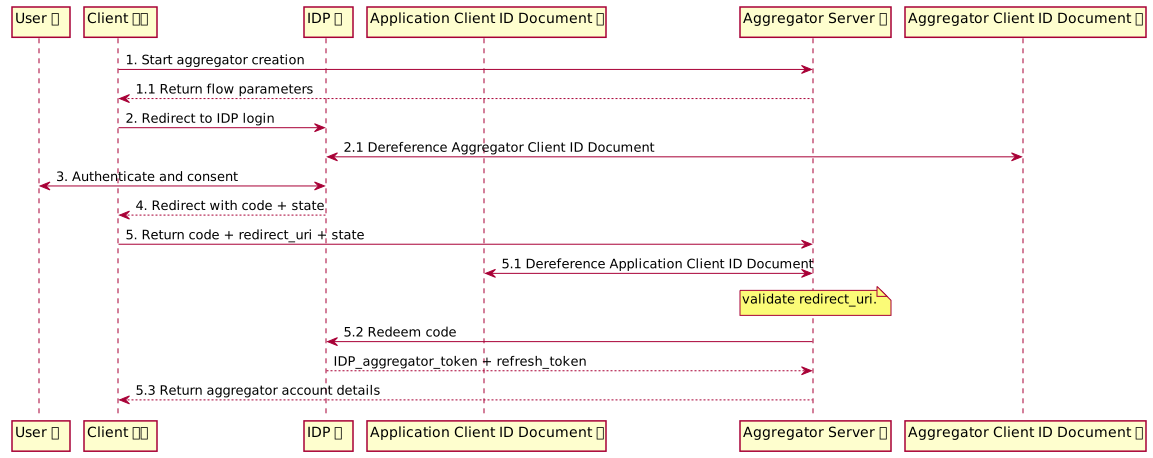
1. Client starts flow with Aggregator Server
The client begins by asking the Aggregator to bootstrap an authorization_code management flow and indicate which
authorization server SHOULD be used. The Aggregator identifies the client application from the
IDP_client_token and responds with the public parameters required for the OIDC authorization request.
POST /registration HTTP / 1.1 Authorization : Bearer <IDP_client_token> Content-Type : application/json { "management_flow" : "authorization_code" , "authorization_server" : "https://as.example" }
1.2 Aggregator responds with public parameters
The Aggregator generates the PKCE verifier/challenge pair plus a random state, persists them together with
the pending management flow, and returns only the public portions (aggregator_client_id, code_challenge,
code_challenge_method, state) to the client application. The authorization_server value identifies the
UMA Authorization Server (AS) that governs access to resources exposed by the Aggregator. The aggregator uses
the IDP_client_token to identify the user’s IdP and Application Client ID Document for the subsequent OIDC
exchange.
HTTP / 1.1 201 Created Content-Type : application/json { "aggregator_client_id" : "https://aggregator.example/client.jsonld" , "code_challenge" : "1uLSZp2..." , "code_challenge_method" : "S256" , "state" : "1eb7c8f5..." }
2. Client sends the end-user through the IDP authorization endpoint
Using the information supplied by the Aggregator, the client constructs an authorization request against the IdP.
GET https://idp.example/authorize?
    response_type=code&
    client_id=https%3A%2F%2Faggregator.example%2Fclient.jsonld&
    redirect_uri=https%3A%2F%2Fapp.example%2Fcallback&
    scope=openid%20webid%20offline_access&
    code_challenge=1uLSZp2...&
    code_challenge_method=S256&
    state=1eb7c8f5...
2.1 IDP dereferences the Aggregator Client ID Document
If the IDP does not already have the aggregator_client_id registered, it dereferences the Aggregator’s
Client ID Document to retrieve the client metadata (for example redirect URIs and other policy-required fields).
3. User authenticates and consents at the IDP
The IDP performs its usual login and consent screens, after which it issues an authorization_code tied to the Aggregator’s client.
4. IDP redirects the user agent back to the client’s redirect_uri
The IDP redirects the user agent back to the client application with the authorization code and the original state.
HTTP / 1.1 302 Found Location : https://app.example/callback?code=SplxlOBeZQQYbYS6WxSbIA&state=1eb7c8f5...
5. Client posts the authorization code back to the Aggregator
The client sends the code, redirect URI, and echoed state to the management endpoint so the Aggregator can finish the flow.
POST /registration HTTP / 1.1 Authorization : Bearer <IDP_client_token> Content-Type : application/json { "management_flow" : "authorization_code" , "code" : "SplxlOBeZQQYbYS6WxSbIA" , "redirect_uri" : "https://app.example/callback" , "state" : "1eb7c8f5..." }
5.1 Aggregator dereferences the client application’s Client ID Document
If no specific redirect URIs were given in the Client ID Document, the Aggregator dereferences the
https://app.example/client.jsonld JSON-LD document to confirm the registered redirect URIs. The aggregator then verifies
that the supplied redirect_uri belongs to that set and that the returned state matches the stored state.
5.2 Aggregator redeems the authorization code at the IDP token endpoint
POST /token HTTP / 1.1 Host : idp.example Content-Type : application/x-www-form-urlencoded Authorization : Basic <aggregator-client-auth> grant_type = authorization_code & code = SplxlOBeZQQYbYS6WxSbIA & redirect_uri = https%3A%2F%2Fapp.example%2Fcallback & client_id = https%3A%2F%2Faggregator.example%2Fclient.jsonld & code_verifier = Hjs8...stored...
The IDP verifies the authorization_code, ensures the redirect_uri matches the original authorization request,
and recomputes the PKCE challenge from the supplied code_verifier. If everything matches, it returns:
HTTP / 1.1 200 OK Content-Type : application/json { "access_token" : "<IDP_aggregator_token>" , "refresh_token" : "<refresh_token>" , "token_type" : "Bearer" , "expires_in" : 3600 }
5.3 Aggregator finalizes the account and responds
Using the issued tokens, the Aggregator creates the aggregator account linked to the user and returns the aggregator description (§ 8.1 Aggregator Description).
HTTP / 1.1 201 Created Content-Type : application/json { "aggregator" : "https://aggregator.example/aggregators/agg-6780/" }
6.2.3. Creation device_code Flow
The device_code flow allows headless components (for example CLI tools) to authenticate an Aggregator
Instance by using the OAuth 2.0 Device Authorization Grant [RFC8628].
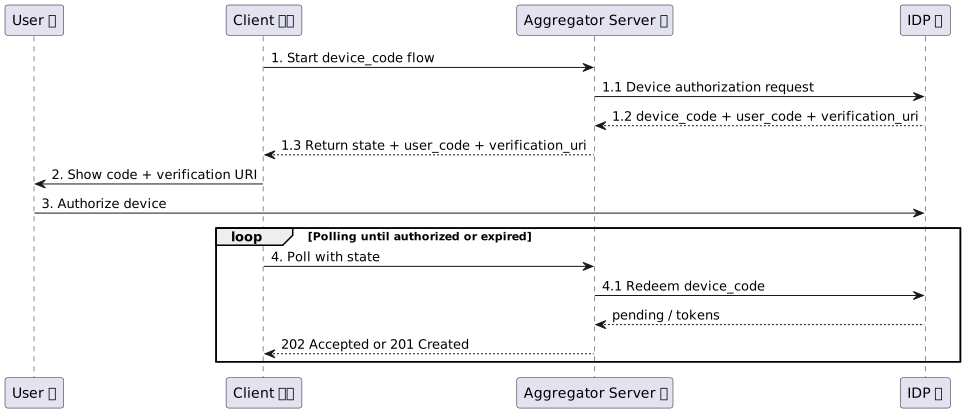
1. Client starts flow with Aggregator Server
The client calls the management endpoint authenticated with its IDP_client_token, indicating the
authorization server that governs access to resources exposed by the Aggregator.
POST /registration HTTP / 1.1 Authorization : Bearer <IDP_client_token> Content-Type : application/json { "management_flow" : "device_code" , "authorization_server" : "https://as.example" }
1.1 Aggregator Server requests device authorization from the IdP
The Aggregator determines the IdP from the IDP_client_token in the authorization header, and sends a device
authorization request to the IdP’s device authorization endpoint.
POST /device_authorization HTTP / 1.1 Host : idp.example Content-Type : application/x-www-form-urlencoded client_id=<aggregator-client-id>&scope = openid%20webid%20offline_access
1.2 IdP responds with device authorization parameters
The IdP responds with the device authorization parameters, including the device_code, user_code, verification_uri,
expires_in, and other optional parameters.
HTTP / 1.1 200 OK Content-Type : application/json {"device_code" : "device-code-xyz" , "user_code" : "WDJB-MJHT" , "verification_uri" : "https://idp.example/activate" , "verification_uri_complete" : "https://idp.example/activate?user_code=WDJB-MJHT" , "expires_in" : 600 , "interval" : 5 }
1.3 Aggregator Server returns device authorization parameters
The Aggregator securely stores the device_code and generates a random state value to track the pending
management flow. It responds to the client with the state, user_code, verification_uri, expires_in, and the
optional other parameters. The device_code is confidential and MUST NOT be returned to the client.
HTTP / 1.1 201 Created Content-Type : application/json { "state" : "state-abc" , "user_code" : "WDJB-MJHT" , "verification_uri" : "https://idp.example/activate" , "verification_uri_complete" : "https://idp.example/activate?user_code=WDJB-MJHT" , "expires_in" : 600 , "interval" : 5 }
2. User authorizes at the IdP
The client prompts the user to visit the verification URI and enter the user code to authorize access.
3. Client polls Aggregator Server
The client polls the management endpoint using the state value, waiting at least the returned
interval (if provided) between polls. The Aggregator polls the IdP token endpoint using the stored
device code until the user authorizes or the device code expires.
POST /registration HTTP / 1.1 Authorization : Bearer <IDP_client_token> Content-Type : application/json { "management_flow" : "device_code" , "state" : "state-abc" }
If authorization is not yet complete, the Aggregator responds with 202 Accepted:
Once authorization succeeds, the Aggregator creates the Aggregator Instance and responds as for other successful create operations:
HTTP / 1.1 201 Created Content-Type : application/json { "aggregator" : "https://aggregator.example/aggregators/agg-5670/" }
Example server-side token polling (Non-normative)
While polling, the IdP can return an authorization-pending error:
POST /token HTTP / 1.1 Host : idp.example Content-Type : application/x-www-form-urlencoded grant_type = urn:ietf:params:oauth:grant-type:device_code & device_code = GmRhmhcxhwAzkoEqiMEg_DnyEysNkuNhszIySk9eS
Once the user completes authorization, the IdP returns the token set:
HTTP / 1.1 200 OK Content-Type : application/json { "access_token" : "<IDP_aggregator_token>" , "refresh_token" : "<refresh_token>" , "token_type" : "Bearer" , "expires_in" : 7200 }
6.2.4. Token Update Flow
This flow allows users to replace the stored access token and refresh token for an existing Aggregator Instance. This is not a refresh-token grant: even refresh tokens can expire, so the client repeats the original management flow to obtain a new set of tokens (and refresh tokens) for the Aggregator Instance.
The flow is the same as creating an Aggregator Instance but an aggregator member is provided in the start request.
The exact steps depend on the management_flow used when creating the Aggregator Instance.
For example, for the authorization_code flow:
POST /registration HTTP / 1.1 Authorization : Bearer <IDP_client_token> Content-Type : application/json {"management_flow" : "authorization_code" , "aggregator" : "https://aggregator.example/aggregators/agg-7890/" }
6.2.5. Aggregator Listing Flow
This flow allows users to list Aggregator Instances by sending a GET request to the management_endpoint.
HTTP / 1.1 200 OK Content-Type : application/json [ "https://aggregator.example/aggregators/agg-7890/" , "https://aggregator.example/aggregators/agg-9012/" ]
6.2.6. Aggregator Deletion Flow
This flow allows users to delete an existing Aggregator Instance by sending a DELETE request to the
management_endpoint with the aggregator member.
DELETE /registration HTTP / 1.1 Authorization : Bearer <IDP_client_token> Content-Type : application/json {"aggregator" : "https://aggregator.example/aggregators/agg-7890/" }
7. Aggregator Security Model (Authentication & Authorization)
This section describes how the Aggregator handles authentication and authorization for:
-
outgoing requests from the Aggregator to upstream Resource Servers; and
-
incoming requests from Clients to the Aggregator’s derived resources.
The Aggregator relies on the Authorization for Data Spaces (A4DS) specification [A4DS] to authenticate participants and authorize access to resources. For streaming or non-HTTP interfaces, the Aggregator MAY additionally use the Service Authorization for Data Spaces (SA4DS) specification [SA4DS]. All Aggregator instance endpoints are protected using User-Managed Access (UMA) [UMA].
The following terms are used throughout this section:
-
The Upstream Resource Server (URS) hosts the original data that the Aggregator consumes.
-
The Upstream Authorization Server (UAS) protects the URS and issues access tokens for upstream resources.
-
The Aggregator Authorization Server (AAS) protects the Aggregator itself and issues tokens (e.g., UMA RPTs) for access to derived resources.
NOTE: The behavior described in this section extends the [A4DS] specification.
7.1. Upstream Access
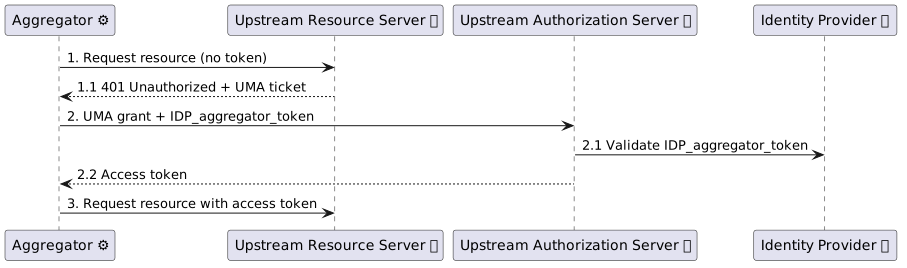
The Aggregator MUST obtain upstream access tokens following the UMA grant flow defined in [A4DS]. When the
UAS requests proof of identity, the Aggregator MUST present the ID token (IDP_aggregator_token) obtained
during aggregator creation (§ 6 Aggregator Management) as its identity claim, with claim_token_format
http://openid.net/specs/openid-connect-core-1_0.html#IDToken.
7.2. Client Access
All instance-level resources of an Aggregator MUST be registered at the AAS, following the model defined in [A4DS], with the scopes necessary for their protection determined by the implementation.
Each implementation SHOULD document:
-
which scopes are registered for each resource; and
-
which scope, or combination of scopes, is required to authorize each action on that resource.
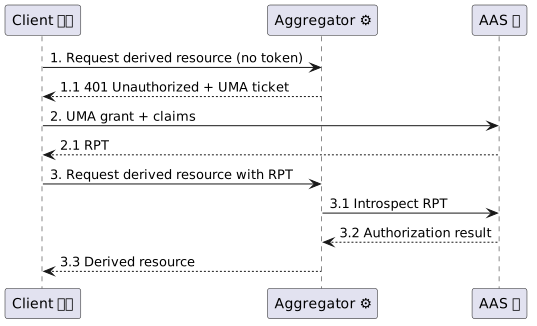
When the Aggregator receives a request without a valid Requesting Party Token (RPT), or with an RPT that does
not grant sufficient permissions, it MUST request a UMA ticket from the AAS and return a 401 Unauthorized response
containing that ticket. The Client MUST present the ticket to the AAS and satisfy the applicable claims-based policies
to obtain an RPT, following the UMA grant flow defined in [A4DS]. The Aggregator MUST validate or introspect
the RPT before serving the derived resource. The Aggregator MAY implement SA4DS for streaming or non-HTTP interfaces.
7.3. Advanced Features
The features in this section extend the baseline flows above. They MAY be implemented by conforming Aggregator Services and their associated Authorization Servers.
7.3.1. Transformation Claims
When the UAS requires details about the intended data transformation before granting access, the Aggregator
MAY include a transformation description as a claim token in the UMA grant request. The claim_type for a
transformation description MUST be https://w3id.org/aggregator#transformation-description. The claim_token_format
MUST identify the RDF serialization of the description as a URI (e.g., http://www.w3.org/ns/formats/Turtle). If the
UAS requires this claim and the Aggregator has not provided one, the UAS MUST respond with a UMA need_info error and
a required_claims entry as defined in [A4DS]. If the transformation description or its associated catalog entry is
dereferenceable by the UAS, the Aggregator MAY provide a URI reference rather than embedding the description inline.
This extends the upstream access flow between steps 2 and 3:
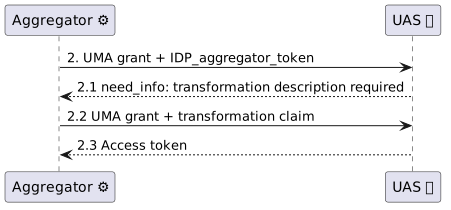
2.1 UAS requests transformation claim
{ "error" : "need_info" , "ticket" : "tkt2-URS-xyz" , "required_claims" : [ { "claim_type" : "https://w3id.org/aggregator#transformation-description" , "friendly_name" : "Intended data transformation" , "claim_token_format" : [ "http://www.w3.org/ns/formats/Turtle" , "http://www.w3.org/ns/formats/JSON-LD" ], "claim_description" : "Describe the transformation that will be executed on the requested data (e.g. query, mapping, model, or workflow reference)." } ] }
2.2 Aggregator resubmits with transformation claim
POST /token HTTP / 1.1 Host : upstream.as.example.org Content-Type : application/json { "grant_type" : "urn:ietf:params:oauth:grant-type:uma-ticket" , "ticket" : "tkt2-URS-xyz" , "claim_token" : "<transformation_description>" , "claim_token_format" : "http://www.w3.org/ns/formats/Turtle" }
7.3.2. Access Delegation via Derivation Resource Identifiers
Access delegation allows upstream data owners to retain policy control over who MAY access derived resources after
those resources have been transformed and republished by an Aggregator Service. It operates through a
derivation_resource_id issued by the UAS that binds the upstream resource, the intended transformation, and the
resulting derived resource. Clients wishing to access a derived resource MUST demonstrate to the AAS they have been
granted access to all of these derivation_resource_id’s by the UAS’s.
7.3.2.1. Upstream: Requesting Derivation Creation Access
When the Aggregator intends to create a derived resource, it MUST include the scope
urn:knows:uma:scopes:derivation-creation in the UMA token request to the UAS. If the URS is itself an Aggregator
Service, the same scope MUST be included in that nested request as well.
If the UAS grants access for derivation creation, it MUST include a derivation_resource_id and a
management_access_token as top-level members in the token response alongside the standard OAuth 2.0 parameters. The
derivation_resource_id is a stable identifier string that binds the upstream resource and transformation to the
derived resource the Aggregator will create. If the Aggregator does not receive a derivation_resource_id, it MUST
NOT use the upstream resource to create derived resources.
If the Aggregator previously obtained a derivation_resource_id for the same upstream resource and
transformation, it SHOULD include it as a hint in the token request. The UAS SHOULD reuse it if the hint is still
valid and bound to the authenticated Aggregator and resource; otherwise it SHOULD ignore the hint and issue a new
identifier.
The management_access_token is an object with access_token and token_type fields that allows the Aggregator
Service to manage the lifecycle of the derivation_resource_id at the UAS through the resource registration endpoint
defined in [A4DS]. Authorization Servers MUST only permit a management_access_token to be used for inspecting or
modifying the derivation_resource_id resource linked to it, and MUST NOT permit it to create new resources. If the
management_access_token is no longer valid, the Aggregator MAY obtain a new one by repeating the token request
including the same derivation_resource_id.
After obtaining the derivation_resource_id, the Aggregator SHOULD update the corresponding resource entry on the UAS
to include at minimum the resource_scopes of the derived resource, and SHOULD also include its name,
description, and icon_uri. This allows the UAS to validate scope requests from Clients and apply policies
accordingly.
The Aggregator MUST update the resource registration of the derived resource at the AAS to include a
derived_from entry containing the issuer (the UAS) and derivation_resource_id. The AAS MUST expire any
previously issued access tokens for that derived resource upon this update. The Aggregator SHOULD only begin
serving the derived resource after this AAS registration update has succeeded.
If access to the upstream resource is revoked for the Aggregator, the UAS MUST also revoke all associated
derivation_resource_id identifiers and their related tokens. When a derived resource is no longer in use, the
Aggregator SHOULD remove the derived_from entry at the AAS, MAY expire previous access tokens, and SHOULD
delete the derivation_resource_id at the UAS using the management_access_token.
This extends the upstream access flow after step 2:
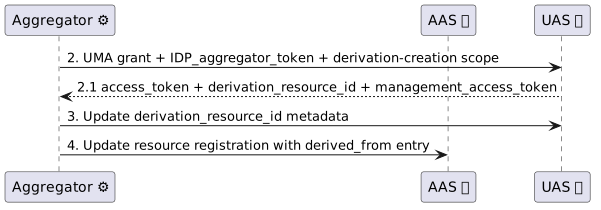
2.1 UAS returns access token with derivation resource identifier
{ "access_token" : "<upstream_access_token>" , "token_type" : "Bearer" , "derivation_resource_id" : "handle-id-1" , "management_access_token" : { "access_token" : "<management_access_token>" , "token_type" : "Bearer" } }
3. Aggregator updates derivation_resource_id metadata on UAS
PUT /derivation-resources/handle-id-1 HTTP / 1.1 Host : upstream.as.example.org Authorization : Bearer <management_access_token> Content-Type : application/json { "type" : "https://agg.example.org/derivation-result" , "name" : "Derived Resource 123" , "description" : "<transformation_description>" , "icon_uri" : "https://agg.example.org/icons/derived-resource-123.png" , "resource_scopes" : [ "urn:knows:uma:scopes:read" ] }
4. Aggregator updates resource registration at AAS with derived_from entry
{ "name" : "Derived Resource 123" , "derived_from" : [ { "issuer" : "https://upstream.as.example.org" , "derivation_resource_id" : "handle-id-1" } ], "resource_scopes" : [ "urn:knows:uma:scopes:read" ] }
7.3.2.2. Client Access to Delegated Derived Resources
When a derived resource has a derived_from entry in its AAS registration, the AAS MUST enforce that Clients
demonstrate access to each listed derivation_resource_id before issuing an RPT.
If the Client presents a ticket for such a resource without the required upstream claim tokens, the AAS MUST respond
with a need_info error. The required_claims array MUST contain one entry per upstream dependency, each with:
-
claim_type: MUST equalhttps://w3id.org/aggregator#derivation-access. -
claim_token_format: MUST equalurn:ietf:params:oauth:token-type:access_token. -
issuer: The UAS from which the Client MUST obtain an upstream access token. -
derivation_resource_id: The resource identifier the Client MUST request access to at the UAS. -
resource_scopes: The scopes the Client MUST request on that resource.
The Client MUST request an access token from each issuer listed in required_claims, using a UMA permissions
request with resource_id set to derivation_resource_id and resource_scopes as specified. The Client MUST then
present each obtained upstream access token as a claim token to the AAS with claim_token_format
urn:ietf:params:oauth:token-type:access_token. The AAS MUST validate each presented upstream access token with its
corresponding UAS before issuing an RPT. The Aggregator SHOULD verify that the derivation_resource_id
associated with the derived resource remains valid at the UAS before serving it, using the management_access_token
on the resource registration endpoint defined in [A4DS].
This extends the client access flow between steps 2 and 3:
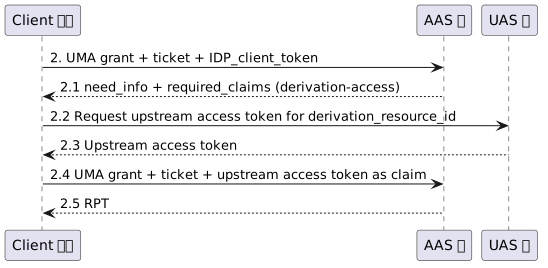
2.1 AAS responds with need_info requesting upstream access token
{ "error" : "need_info" , "ticket" : "tkt-2" , "required_claims" : [ { "claim_type" : "https://w3id.org/aggregator#derivation-access" , "claim_token_format" : "urn:ietf:params:oauth:token-type:access_token" , "issuer" : "https://upstream.as.example.org" , "derivation_resource_id" : "handle-id-1" , "resource_scopes" : [ "urn:knows:uma:scopes:read" ] } ] }
2.2 Client requests upstream access token from UAS
{ "grant_type" : "urn:ietf:params:oauth:grant-type:uma-ticket" , "permissions" : [ { "resource_id" : "handle-id-1" , "resource_scopes" : [ "urn:knows:uma:scopes:read" ] } ], "claim_token" : "<IDP_client_token>" , "claim_token_format" : "http://openid.net/specs/openid-connect-core-1_0.html#IDToken" }
2.3 UAS returns upstream access token
2.4 Client resubmits with upstream access token as claim
{ "grant_type" : "urn:ietf:params:oauth:grant-type:uma-ticket" , "ticket" : "tkt-2" , "claim_token_format" : "urn:ietf:params:oauth:token-type:access_token" , "claim_token" : "RPT-uas-xyz" }
2.5 AAS validates upstream token and issues RPT
The AAS validates the upstream access token with the UAS. If all policy checks succeed, it issues an RPT. The Client then proceeds as in the baseline client access flow from step 3.
8. Aggregator Metadata
This endpoint provides metadata about the Aggregator Instance. Deployments MAY choose arbitrary paths for instance-level
endpoints. The Aggregator Metadata representation MUST include absolute URLs for those resources (e.g., the
service_catalog and service_collection_endpoint fields) so clients can discover the deployment-specific layout.
8.1. Aggregator Description
The Aggregator Metadata resource (aggregator-url) allows clients to retrieve the current status of their aggregator.
This endpoint MUST be guarded by the authentication and authorization mechanisms described in the
§ 7 Aggregator Security Model (Authentication & Authorization). It MUST be accessible as JSON using application/json and MAY additionally expose
semantically annotated RDF representations (for example JSON-LD or Turtle) using HTTP content negotiation based on
[RFC9110].
The endpoint MUST return at least the following information about the aggregator, but additional fields MAY be
included as needed. Each field SHOULD be expressed using the RDF properties defined in § 10 Vocabulary so the document MAY
be served as JSON-LD or other RDF formats. In semantically annotated representations, the Aggregator Description MUST state
that the described resource has RDF type aggr:Aggregator (§ 10.1.1 aggr:Aggregator) (e.g., via @type in JSON-LD or
a aggr:Aggregator in Turtle). Clients MAY rely on this type statement when consuming semantic representations.
- id (OPTIONAL):
-
The value is a string containing the absolute URL that identifies the Aggregator Instance (typically the instance base URL itself); in the RDF representations, this is the RDF subject (i.e.,
@id) of theaggr:Aggregatorresource (§ 10.1.1 aggr:Aggregator). - created_at (REQUIRED):
-
The value is a string timestamp (recommended:
xsd:dateTimelexical form, e.g., RFC 3339 [RFC3339]); in the RDF representations, this member maps to the predicateaggr:createdAt(§ 10.2.1 aggr:createdAt). - login_status (REQUIRED):
-
The value is a boolean that indicates whether the stored token set for the aggregator is currently valid; in the RDF representations, this member maps to the predicate
aggr:loginStatus(§ 10.2.2 aggr:loginStatus). - token_expiry (OPTIONAL):
-
The value is a string timestamp indicating when the aggregator’s access token will expire (recommended:
xsd:dateTimelexical form, e.g., RFC 3339 [RFC3339]); in the RDF representations, this member maps to the predicateaggr:tokenExpiry(§ 10.2.3 aggr:tokenExpiry). - service_catalog (REQUIRED):
-
The value is a string containing the absolute URL of the instance’s Service Catalog (§ 8.2 Instance-level Service Catalog); in the RDF representations, this member maps to the predicate
aggr:serviceCatalog(§ 10.2.23 aggr:serviceCatalog). - service_collection_endpoint (REQUIRED):
-
The value is a string containing the absolute URL of the instance’s Service Collection to create and fetch the Aggregator Services (§ 9.1 Service Collection Endpoint); in the RDF representations, this member maps to the predicate
aggr:serviceCollectionEndpoint(§ 10.2.4 aggr:serviceCollectionEndpoint).
This document MAY be the WebID of the Aggregator Instance when the provision flow § 6.2.1 Creation provision Flow was used. In
that case this document MUST be an RDF document that conforms to the WebID Profile specification [WEBID-PROFILE].
{ "@context" : "https://w3id.org/aggregator/contexts/aggregator-description.jsonld" , "aggregator_base_url" : "https://aggregator.example/aggregators/agg-7890/" , "type" : "Aggregator" , "created_at" : "2025-12-17T17:20:00Z" , "login_status" : true , "token_expiry" : "2025-12-17T18:20:00Z" , "service_catalog" : "https://aggregator.example/aggregators/agg-7890/service-catalog" , "service_collection_endpoint" : "https://aggregator.example/aggregators/agg-7890/services" , "oidcIssuer" : "https://issuer.example/" }
8.2. Instance-level Service Catalog
This endpoint is the instance-level extension of the server-level Service Catalog defined in § 5.3 Server-level Service Catalog. It allows the Aggregator Server to make certain deployment functions available only to specific Aggregator instances by curating the catalog’s contents per instance.
Aggregator servers MUST publish this catalog at a deployment-specific URL of their choosing. This URL MUST
be advertised in the § 8.1 Aggregator Description via the service_catalog field. The endpoint
MUST follow the same content negotiation rules, and other requirements, as the server-level Service
Catalog. Resources referenced by this Instance-Level Service Catalog MAY either be included directly in
the RDF document or hosted by the Aggregator Server in separate documents. This Instance-Level Service
Catalog, along with each resource referenced by it, MUST be protected using the § 7 Aggregator Security Model (Authentication & Authorization).
9. Aggregator Service Management
This section describes how users manage services deployed on an aggregator.
The Service Collection endpoint (§ 9.1 Service Collection Endpoint), which allows clients to:
-
Discover running services on an aggregator (§ 9.1.2 Service Discovery)
-
Deploy new services on an aggregator (§ 9.1.1 Deploying a Service)
Each deployed service MUST expose its own Service Description endpoint (§ 9.2 Service Description Endpoint), which allows clients to:
-
Inspect the service metadata (e.g. status)
-
Discover its capabilities
-
Delete the service
All endpoints described in this section MUST be protected using the authentication and authorization mechanisms defined in § 7 Aggregator Security Model (Authentication & Authorization).
9.1. Service Collection Endpoint
The location of this endpoint MUST be advertised in the Aggregator Description (§ 8.1 Aggregator Description)
using the service_collection_endpoint field. Clients MUST treat the advertised URL as authoritative and MUST NOT
assume a fixed path. Examples shown in this section use https://aggregator.example/agg1/services for illustration purposes only.
9.1.1. Deploying a Service
The Service Collection Endpoint MUST allow POST requests to deploy a new service.
The Service Collection Endpoint MAY allow POST requests to deploy new services. The supported content types MUST be
advertised via the Accept-Post header defined in [LDP]. The POST request to deploy a new services MUST be
authorized with the create scope on the Service Collection Endpoint.
The request body MAY allow POST requests to deploy new services. The supported content types MUST be
advertised via the Accept-Post header defined in [LDP]. If the request body is a JSON-LD payload, it MUST use at
least the predefined JSON-LD context https://w3id.org/aggregator/contexts/aggregator.jsonld, representing an
aggr:ServiceRequest.
The aggr:ServiceRequest:
-
MUST be the only
aggr:ServiceRequestdescribed in the request body. -
MUST be identified using either a unique URI or a blank node.
-
MUST identify a deployment function using
deploymentFunction. -
MUST provide inputs for at least all required parameters, using the parameter predicates defined using
fno:predicatein the function description. -
MAY specify an implementation to use with
implements.
The Service Request MAY be identified by a blank node or a URI indicating the desired Service endpoint location.
The Aggregator MAY ignore the requested URI and assign its own. If the requested URI is syntactically invalid
or not permitted, the server MUST respond with 400 Bad Request. If the requested URI is valid but already in use,
the server MUST respond with 409 Conflict.
Upon successful processing, the Aggregator MUST:
-
Invoke the deployment function identified by
deploymentFunctionwith the inputs from the Service Request. -
Deploy the resulting Service and expose a Service Description Endpoint § 9.2 Service Description Endpoint, describing it according to the data model in § 4.3 Service. The Service description MUST reference the deployment function using
aggr:deploymentFunction. -
Update the Service Collection and its associated ETag.
-
Register the Service Description Endpoint as a UMA resource at the Authorization Server, advertising at least the
read,update, anddeletescopes. -
Register each distinct Service output endpoint URL as an UMA resource.
-
Respond with
201 Created, including the Service description (as defined in § 4.3 Service) in the response body and aLocationheader identifying the Service Description Endpoint.
Error Responses:
-
MUST respond with
400 Bad Requestif the requested URI is syntactically invalid or not permitted. -
MUST respond with
409 Conflictif the requested URI is valid but already in use. -
MUST respond with
400 Bad Requestif the request body is syntactically malformed or semantically invalid (e.g., missing required parameter values or referencing an unknown deployment function). -
MUST respond with
500 Internal Server Errorif the request is valid but the Aggregator fails to deploy the Service.
The following example depicts a request that invokes the QueryViewDeployment deployment function.
POST https://aggregator.example/agg1/services HTTP / 1.1 Host : aggregator.example Content-Type : application/ld+json { "@context" : [ "https://w3id.org/aggregator/contexts/aggregator.jsonld" , { "query" : "https://aggregator.example/deployments#query" , "source" : "https://aggregator.example/deployments#source" } ], "@id" : "https://aggregator.example/agg1/services/query-view-service/" , "@type" : "ServiceRequest" , "deploymentFunction" : "https://aggregator.example/deployments#QueryViewDeployment" , "implements" : "https://aggregator.example/deployments#QueryViewIncremunica" , "query" : "SELECT * WHERE { ?s ?p ?o }" , "source" : "http://example.org/source" }
9.1.2. Service Discovery
The Service Collection Endpoint MUST expose an RDF document whose base resource, identified by the document’s
own retrieval URL, MUST be described as an aggr:ServiceCollection (§ 4.4 Service Collection).
The endpoint SHOULD support HTTP content negotiation to allow clients to request different RDF serializations
(e.g., Turtle, JSON-LD) of the RDF Document.
HEAD-
Enables clients to detect changes to the collection without retrieving the full representation. The server MUST respond with:
-
200 OK -
An
ETagheader whose value changes whenever a service is added to or removed from the collection.
-
GET-
Returns the service collection RDF Document. The server MUST respond with:
-
200 OK -
The same
ETagvalue that would be returned in response to aHEADrequest -
The serialized service collection in the body
-
9.2. Service Description Endpoint
The Service Description Endpoint MUST expose the § 4.3 Service. It is also used to delete the corresponding service. This endpoint SHOULD support HTTP content negotiation as defined in [RFC9110].
GET-
Retrieves the service description (as defined in § 4.3 Service).
-
The server MUST respond with
200 OK.
-
DELETE-
Deletes a running Aggregator Service.
-
Upon successful processing, the Aggregator MUST:
-
Stop and remove the running service from the Aggregator.
-
Update the Service Collection and its associated
ETag. -
Delete the corresponding UMA resources at the Authorization Server.
-
Respond with either
200 OKor204 No Content.
-
-
If the service does not exist, the Aggregator SHOULD respond with
404 Not Found.
-
Next to the GET and DELETE methods, the server MAY support:
PATCH-
Updates the service description (as defined in § 4.3 Service).
-
The server MUST respond with
200 OKand include the updated service description in the response body. -
If the service does not exist, the Aggregator SHOULD respond with
404 Not Found. -
If the server supports
PATCH, it MUST advertise the supported patch document formats using the HTTPAccept-Patchheader. -
If the request
Content-Typeis not a supported patch document format, the server MUST respond with415 Unsupported Media Type. -
If the request is syntactically malformed or semantically invalid, the server MUST respond with
400 Bad Request. -
If the request is valid but the service fails to update, the server MUST respond with
500 Internal Server Error.
-
PUT-
Replaces the service description (as defined in § 4.3 Service).
-
The server MUST respond with
200 OKand include the updated service description in the response body. -
If the service does not exist, the Aggregator SHOULD respond with
404 Not Found. -
If the request is syntactically malformed or semantically invalid, the server MUST respond with
400 Bad Request. -
If the request is valid but the service fails to update, the server MUST respond with
500 Internal Server Error.
-
When the server supports PATCH or PUT, it SHOULD NOT allow the user to remove or modify values that are managed by
the Aggregator itself. This includes at least the service identifier, the RDF types of the service, aggr:createdAt,
aggr:status, aggr:statusDetail, dcat:servesDataset, and dcat:distribution. If a PATCH or
PUT request attempts to remove or modify such values, the server SHOULD respond with
400 Bad Request.
9.2.1. Service Output Endpoints
Each Service Output Endpoint MUST be hosted at the same URL as the one referenced via dcat:accessURL in a
corresponding service dcat:Distribution. Each Service Output Endpoint is the access interface for that distribution.
It is distinct from the dcat:Dataset resource identified in the service description and MUST NOT itself be
interpreted as the dataset.
10. Vocabulary
The Aggregator vocabulary is defined in the aggr: namespace
(https://w3id.org/aggregator#). The following classes and properties are used
throughout this specification.
10.1. Classes
10.1.1. aggr:Aggregator
Describes an Aggregator Instance (its base URL is the Aggregator Description resource).type: rdfs:Class
subClassOf: schema:Service
subClassOf: foaf:Agent
10.1.2. aggr:Service
Represents a configured Aggregator Service that can be created, inspected, and removed via the Service Management API (e.g.,/services/{service_id}).
type: rdfs:Class
subClassOf: prov:SoftwareAgent,
dcat:DataService
10.1.3. aggr:AggregatorServer
Describes the Aggregator Server Description document that advertises discovery metadata.type: rdfs:Class
subClassOf: schema:Service
10.1.4. aggr:ServiceCollection
Describes the service collection resource (e.g.,/services).
type: rdfs:Class
subClassOf: schema:Collection,
hydra:Collection
10.1.5. aggr:ServiceCatalog
Describes a service catalog resource that lists the deployment functions supported by an Aggregator Server (and optionally instance-specific deployment functions).type: rdfs:Class
subClassOf: schema:Collection,
hydra:Collection
10.1.6. aggr:ProvenanceLog
Describes a collection of provenance activities associated with a running Aggregator Service.type: rdfs:Class
subClassOf: schema:Collection,
hydra:Collection
10.1.7. aggr:ServiceRequest
Describes a request to deploy an Aggregator Service on an Aggregatortype: rdfs:Class
10.1.8. aggr:ManagementFlow
Describes a management flow supported by an Aggregator Server. This specification models each flow as an RDF class so thataggr:supportedManagementFlow can be
semantically annotated by referencing the relevant flow class (e.g., aggr:AuthorizationCodeFlow).
type: rdfs:Class
subClassOf: rdfs:Class
10.1.9. aggr:NoAuthFlow
Management flow where the Aggregator Instance does not authenticate and only accesses public resources.type: rdfs:Class
subClassOf: aggr:ManagementFlow
10.1.10. aggr:ProvisionFlow
Management flow where the Aggregator Server provisions an Aggregator Instance with its own identity.type: rdfs:Class
subClassOf: aggr:ManagementFlow
10.1.11. aggr:AuthorizationCodeFlow
Management flow based on OAuth 2.0 Authorization Code [RFC6749] (https://datatracker.ietf.org/doc/html/rfc6749) (via OpenID Connect), where the Aggregator acts on behalf of an end-user with a token scoped to the Aggregator.type: rdfs:Class
subClassOf: aggr:ManagementFlow
10.1.12. aggr:DeviceCodeFlow
Management flow based on OAuth 2.0 Device Authorization Grant [RFC8628].type: rdfs:Class
subClassOf: aggr:ManagementFlow
10.2. Properties
10.2.1. aggr:createdAt
Timestamp when anaggr:Aggregator or aggr:Service was created.
type: rdf:Property
domain: aggr:Aggregator, aggr:Service
range: xsd:dateTime
10.2.2. aggr:loginStatus
Indicates whether the stored token set for anaggr:Aggregator is currently valid.
type: rdf:Property
domain: aggr:Aggregator
range: xsd:boolean
10.2.3. aggr:tokenExpiry
Timestamp when the current access token for anaggr:Aggregator will expire.
type: rdf:Property
domain: aggr:Aggregator
range: xsd:dateTime
10.2.4. aggr:serviceCollectionEndpoint
Links anaggr:Aggregator to its service collection endpoint.
type: rdf:Property
domain: aggr:Aggregator
range: xsd:anyURI
10.2.5. aggr:hasService
Links anaggr:ServiceCollection to the aggr:Service instances it advertises.
type: rdf:Property
domain: aggr:ServiceCollection
range: aggr:Service
10.2.6. aggr:hasDeploymentFunction
Links anaggr:ServiceCatalog to a supported fno:Function that deploys one or more Aggregator Services.
type: rdf:Property
domain: aggr:ServiceCatalog
range: fno:Function
10.2.7. aggr:hasAlgorithm
Links anaggr:ServiceCatalog to an algorithm it supports.
type: rdf:Property
domain: aggr:ServiceCatalog
range: fno:Algorithm
10.2.8. aggr:hasMapping
Links anaggr:ServiceCatalog to a mapping it supports.
type: rdf:Property
domain: aggr:ServiceCatalog
range: fno:Mapping
10.2.9. aggr:status
Provides the lifecycle phase of anaggr:Service (values such as running, stopped, or error).
type: rdf:Property
domain: aggr:Service
range: xsd:string
10.2.10. aggr:statusDetail
Provides a human-readable explanation of the currentaggr:Service status (for example, a stop reason or error message).
type: rdf:Property
domain: aggr:Service
range: xsd:string
10.2.11. aggr:deploymentFunction
Links a service request and its resulting service to the FnO function used to deploy the service. The deployment function describes service creation and does not necessarily describe functionality performed by the deployed service.type: rdf:Property
domain: aggr:Service,
aggr:ServiceRequest
range: fno:Function
10.2.12. aggr:implements
Provides the implementation used by anaggr:Service to perform its transformation.
type: rdf:Property
domain: aggr:Service,
aggr:ServiceRequest
range: fno:Implementation
10.2.13. aggr:fromAggregator
References the base URL of theaggr:Aggregator an Aggregator Instance (or Aggregator Service) resource belongs to.
Used as an HTTP Link header relation ([Web-Linking]) to discover the enclosing Aggregator Instance.
type: rdf:Property
domain: rdfs:Resource
range: aggr:Aggregator
10.2.14. aggr:fromServer
References the base URL of theaggr:AggregatorServer an Aggregator Server, Aggregator Instance, or Aggregator Service
resource belongs to. Used as an HTTP Link header relation ([Web-Linking]) to discover the enclosing Aggregator Server.
type: rdf:Property
domain: rdfs:Resource
range: aggr:AggregatorServer
10.2.15. aggr:fromService
References the base URL of theaggr:Service an Aggregator Service resource belongs to.
Used as an HTTP Link header relation ([Web-Linking]) to discover the enclosing Aggregator Service.
It MAY also be used to link a service output dcat:Distribution to the aggr:Service that exposes it.
type: rdf:Property
domain: rdfs:Resource
range: aggr:Service
10.2.16. aggr:provenanceLog
Links anaggr:Service to its provenance log.
type: rdf:Property
domain: aggr:Service
range: aggr:ProvenanceLog
10.2.17. aggr:hasActivity
Links anaggr:ProvenanceLog to an activity it includes.
type: rdf:Property
domain: aggr:ProvenanceLog
range: prov:Activity
10.2.18. aggr:managementEndpoint
Links anaggr:AggregatorServer to its management endpoint.
type: rdf:Property
domain: aggr:AggregatorServer
range: xsd:anyURI
10.2.19. aggr:supportedManagementFlow
Lists the management flows advertised by anaggr:AggregatorServer.
type: rdf:Property
domain: aggr:AggregatorServer
range: rdfs:Class (expected to be an aggr:ManagementFlow class)
10.2.20. aggr:managementRequestFormatSupported
Lists the supported request formats for anaggr:AggregatorServer management endpoint.
type: rdf:Property
domain: aggr:AggregatorServer
range: xsd:string
10.2.21. aggr:specVersion
States which version of this specification anaggr:AggregatorServer implements.
type: rdf:Property
domain: aggr:AggregatorServer
range: xsd:string
10.2.22. aggr:clientIdentifier
Links anaggr:AggregatorServer to its Client ID Document.
type: rdf:Property
domain: aggr:AggregatorServer
range: xsd:anyURI
10.2.23. aggr:serviceCatalog
References the service catalog of anaggr:Aggregator (its instance-level service catalog) or an
aggr:AggregatorServer (its server-level service catalog).
type: rdf:Property
domain: aggr:Aggregator, aggr:AggregatorServer
range: aggr:ServiceCatalog
10.3. Claim Types
10.3.1. aggr:transformation-description
Identifier for the UMAclaim_type used to request or provide a transformation description.
type: rdfs:Resource
Claim tokens of this type MUST be RDF descriptions of the intended transformation (for example an fno:Execution or a
reference to a service catalog entry). Acceptable claim_token_format values are URIs identifying RDF
serializations (such as http://www.w3.org/ns/formats/Turtle and http://www.w3.org/ns/formats/JSON-LD).
10.3.2. aggr:derivation-access
Identifier for the UMAclaim_type used to request or provide upstream access tokens for derived resources.
type: rdfs:Resource
Claim tokens of this type MUST be access tokens issued by the upstream Authorization Server for the
derivation_resource_id referenced in the claim request.