

1. Introduction
Modern distributed systems increasingly rely on continuous or session-based service interactions—spanning data streams, message brokers, IoT telemetry, or custom transport protocols. Traditional authorization frameworks like OAuth 2.0 and UMA 2.0 primarily target discrete, HTTP-based request/response exchanges. The Service Authorization for Data Spaces (SA4DS) extends A4DS with a simple mechanism for maintaining (continuous) access authorization to non-HTTP services, including streaming resources, while preserving UMA’s policy-driven and decentralized properties. Throughout this document, “stream” is used as a shorthand for these long-lived service interactions. SA4DS does not require clients to understand or request fine-grained authorization semantics; such semantics are optional and Resource Server–defined.
This document defines:
-
An HTTP control interface on the Resource Server (RS) for requesting service tokens that represent authorization for streams and non-HTTP services.
-
The expected interaction between clients, the RS, and the UMA Authorization Server (AS).
-
Generic enforcement behavior for service-oriented transports (SSE, WebRTC, MQTT, Kafka, custom sockets, etc.).
2. Terminology
This specification reuses terms from [oauth20], [uma-fed], [uma-grant], and [a4ds].
This specification also relies on JSON [json], JWT [jwt], bearer token usage [bearer], OAuth token introspection [introspection], HTTP Link headers [link-header], HTTP semantics [http-semantics], HTTP caching [http-caching], well-known URIs [wk-uri], Server-Sent Events [eventsource], WebSockets [websockets], TLS [tls], mutual-TLS OAuth client authentication and certificate-bound access tokens [mtls], and DPoP [dpop] where those mechanisms are used by a deployment.
Additional terms:
-
Service Resource — a service endpoint whose access semantics are continuous or non-HTTP based (e.g., a data stream, message topic, or telemetry channel).
-
Service Token — a short-lived access token issued by the RS that represents the permissions granted by a valid UMA RPT for one or more Service Resources hosted by that RS.
-
Service Token Format — an RS-defined string identifying the format or validation profile of a Service Token, such as an opaque token, a JWT, or a proof-of-possession-bound token. The concrete token representation and validation profile are implementation-specific.
-
Service Token Endpoint — an HTTP endpoint on the RS that exchanges a valid UMA Requesting Party Token (RPT) for a short-lived Service Token that can be used to initiate or maintain access to a Service Resource.
-
Authorization Event Stream — an HTTP event stream on the RS through which the RS sends authorization events for an authorization session to the client. The Authorization Event Stream is separate from the Service Resource data channel.
-
Authorization Session ID — an RS-issued identifier for the authorization session binding a series of Service Tokens and authorization update requests.
-
Authorization Session Token — an RS-issued credential used by the client to authenticate to RS endpoints that manage an authorization session. The Authorization Session Token is not issued by the AS.
3. Service Token Endpoint
The Service Token Endpoint enables a client to exchange a valid UMA Requesting Party Token (RPT) for a short-lived Service Token representing the permissions granted by the RPT for Service Resources hosted by the Resource Server (RS). The Service Token Endpoint is hosted by the RS.
3.1. Endpoint and method
The Service Token Endpoint:
-
MUST support HTTP
POST. -
MUST accept JSON request bodies encoded as
application/json. -
MUST return successful responses encoded as
application/json. -
MUST be discoverable as described in § 5 Discovery.
3.2. Request
The Service Token Endpoint has two request modes:
-
initial Service Token request, where no authorization session exists yet; and
-
authorization session update or refresh, where the client already has an Authorization Session Token.
For an initial Service Token request, the client MUST send:
-
an
Authorizationrequest header with aBearerRPT; and -
if a request body is present, a
Content-Typerequest header set toapplication/json.
The request body for an initial Service Token request MAY be omitted. If present,
the request body MAY be an empty JSON object. The
client does not send resource_url, resource_scopes, or access_description
to the Service Token Endpoint. The RS MUST derive the Service Resource
permissions represented by the Service Token from the validated RPT. It MUST
include only permissions for Service Resources hosted by that RS.
For an authorization session update or refresh request, the client MUST send:
-
an
Authorizationrequest header with aBearerRPT; -
a
Content-Typerequest header set toapplication/json; and -
a JSON request body with an
authorization_session_tokenmember containing the Authorization Session Token for the session being updated or refreshed.
The RS MUST validate that the RPT is valid before issuing a Service Token. The validation mechanism is deployment-specific and can include introspection with the AS. For authorization session update or refresh requests, the RS MUST validate that the Authorization Session Token authenticates the authorization session being updated or refreshed.
The RS MUST verify that the presented RPT authorizes the full permission set needed for the service session. A Service Token issued for an existing authorization session MUST represent the complete currently authorized permission set for that session; its permissions replace, rather than merely supplement, the permissions represented by the previous Service Token.
3.3. Response
On success, the RS MUST return 200 OK with a JSON response body containing:
-
service_token(required, string): A short-lived token issued by the RS that the client presents on the service channel. -
service_token_format(required, string): An RS-defined identifier for the Service Token format or validation profile. This specification does not define a registry or fixed set of values. -
expires_in(required, positive integer): The lifetime of the issued Service Token in seconds, measured from the time the response is generated. Its value MUST reflect the expiration bound defined in § 7 Token Validation and Lifetimes. -
authorization_session_id(required, string): An Authorization Session ID identifying the ongoing authorization session. If no authorization session exists for the request, the RS MUST create one. -
authorization_session_token(required when a new authorization session is created, optional otherwise, string): The Authorization Session Token for the session. If present in a response for an existing session, it replaces the previous Authorization Session Token. -
authorization_events(optional, string): The absolute URL of the RS’s Authorization Event Stream for the authorization session. If present, the client MAY use this URL with the Authorization Session Token to receive authorization events for the session.
The client uses service_token as a bearer or proof-of-possession credential
when initiating the service channel. To maintain continuous access, the client
MUST refresh the Service Token before it expires by obtaining or reusing a valid
RPT and calling the Service Token Endpoint again with the Authorization Session
Token in the request body.
A successful authorization session update or refresh at the Service Token Endpoint proves to the RS that the client remains authorized for the service session. This specification does not require the client to re-authorize on an existing Service Resource connection after that endpoint call.
When accepting a Service Token on a Service Resource connection, the RS MUST associate that connection with the corresponding authorization session. After a successful update or refresh, the RS MUST apply the refreshed authorization state to Service Resource connections associated with that session. The client does not need to present the newly issued Service Token again on those existing connections.
The RS MAY rotate the Authorization Session Token by returning a new
authorization_session_token member in any successful Service Token response.
When a response contains an authorization_session_token for an existing
session, the client MUST use the new token for future requests authenticated to
that authorization session. The RS SHOULD allow a short overlap window during
which the previous Authorization Session Token remains valid for in-flight
requests.
The RS MUST include Cache-Control: no-store in successful responses containing
Service Tokens or Authorization Session Tokens. Clients and intermediaries MUST
NOT store these responses.
3.4. Errors
If a required request body is missing, is not valid JSON, or does not contain
the required members, the RS MUST respond with 400 Bad Request. If the request
body is omitted for an initial Service Token request, the omission is not an
error.
If no valid RPT is provided for an initial, update, or refresh Service Token
request, the RS MUST respond with 401 Unauthorized. If the RS has sufficient
context to identify permissions that the client needs, the response SHOULD
include an UMA WWW-Authenticate header containing a permission ticket (e.g.,
with an as_uri and ticket).
If the RPT in an update or refresh request does not authorize the full permission
set needed for the service session, the RS MUST respond with 401 Unauthorized
and an UMA WWW-Authenticate header containing a permission ticket for the
required permissions.
If the Authorization Session Token is missing, invalid, expired, or does not
authenticate the authorization session being updated, the RS MUST respond with
401 Unauthorized.
4. Authorization Event Stream
The Authorization Event Stream enables the RS to notify a client that the authorization state of a session has changed, without embedding authorization control messages in the Service Resource data channel. This allows the same authorization update mechanism to be used with WebSockets, SSE, databases, message brokers, custom sockets, and other service transports.
The Authorization Event Stream is hosted by the RS. The RS MUST NOT send Service Resource data over the Authorization Event Stream.
4.1. Event stream connection
The Authorization Event Stream endpoint:
-
MUST support HTTP
GET. -
MUST support
text/event-streamresponses as defined by Server-Sent Events. -
MUST require an
Authorizationrequest header with a valid Authorization Session Token. -
MUST only send events for the authorization session authenticated by that token.
The authorization_events URL is an RS-defined absolute URL for an
authorization session. Clients MUST treat the URL as opaque and MUST NOT
construct authorization event stream URLs from an Authorization Session ID.
If the Authorization Session Token is missing, invalid, expired, or does not
authenticate the authorization session associated with the event stream URL, the
RS MUST respond with 401 Unauthorized.
The client MAY connect to the Authorization Event Stream after receiving a
Service Token response containing an authorization_events URL and an
Authorization Session Token. Refreshing a Service Token does not require the
client to reconnect the Authorization Event Stream unless the RS closes the
stream or rejects the current Authorization Session Token.
4.2. Authorization events
Each authorization event MUST contain an SSE event field identifying the
authorization event type and an SSE data field containing a UTF-8 JSON object.
The RS SHOULD include an SSE id field on each authorization event. Event IDs
MUST be unique within an authorization session and MUST be ordered according to
the order in which the RS generated the events for that session. If the client
reconnects with a Last-Event-ID value, the RS SHOULD replay authorization
events generated after that event ID when replay is still available. If replay
is not available, the RS SHOULD require the client to refresh the Service Token
or reconnect the service session.
When the RS rotates an Authorization Session Token, it SHOULD continue accepting the previous Authorization Session Token for the overlap window described in § 3.3 Response on the Authorization Event Stream and Service Token Endpoint. After the overlap window ends, the RS MAY close event streams authenticated with the previous Authorization Session Token or require the client to reconnect using the new token.
Each event object MAY contain:
-
authorization_session_id(optional, string): The Authorization Session ID to which the event applies.
This specification defines the following event types:
-
authorization_required: The current session does not authorize a requested operation. The event object MUST include aticketmember containing an UMA permission ticket. -
token_refresh_required: The client needs to refresh the Service Token for the session because the current Service Token is expired, is about to expire, the underlying authorization is no longer active, or the RS requires a fresh authorization check. The event object MUST include aticketmember containing an UMA permission ticket. The event object MAY includeexpires_in, an integer number of seconds after which the current Service Token will no longer be accepted. -
session_terminated: The RS has terminated the authorization state for the session. The event object MAY includereason, a string indicating why the session was terminated.
When receiving authorization_required, the client SHOULD use the provided UMA
permission ticket to obtain a fresh RPT from the AS, then call the Service Token
Endpoint with the fresh RPT and the Authorization Session Token.
When receiving token_refresh_required, the client SHOULD call the Service
Token Endpoint before the current Service Token expires, using either an
existing valid RPT that authorizes the full permission set needed for the
service session or a fresh RPT obtained from the AS using the provided
permission ticket. The RS includes the ticket so that the client can obtain a
fresh RPT immediately, but the client MAY ignore the ticket when it already has
a suitable RPT. After sending token_refresh_required, the RS MAY continue
sending Service Resource data for a grace period, withhold Service Resource data
until the client refreshes, or terminate the service connection immediately,
according to local policy and transport constraints.
When receiving session_terminated, the client MUST stop using Service Tokens
for that session. The RS MUST stop sending Service Resource data and reject
further service operations for that session. The RS MUST also terminate, or
otherwise make unusable, all Service Resource connections associated with that
session.
5. Discovery
The RS MUST make the Service Token Endpoint discoverable:
-
via a
Linkheader (when the Service Resource is HTTP-based), usingrel="https://spec.knows.idlab.ugent.be/service-authorization-for-data-spaces/service-token-endpoint". -
via the
/.well-known/sa4ds-configurationconfiguration document on the RS, by including aservice_token_endpointmember.
The RS MUST make an Authorization Event Stream URL discoverable only by
returning an authorization_events member in a successful Service Token
response. The returned URL is specific to the authorization session.
When the Service Resource is HTTP-based and the client does not present a valid
Service Token, the RS SHOULD combine authorization challenge and endpoint
discovery in the same 401 Unauthorized response. The response SHOULD include
an UMA WWW-Authenticate header containing a permission ticket for the
requested Service Resource and scopes, and a Link header identifying the
Service Token Endpoint.
/.well-known/sa4ds-configuration is not yet registered.
Non-normative discovery examples are provided in flow examples.
6. Flow (Non-normative)
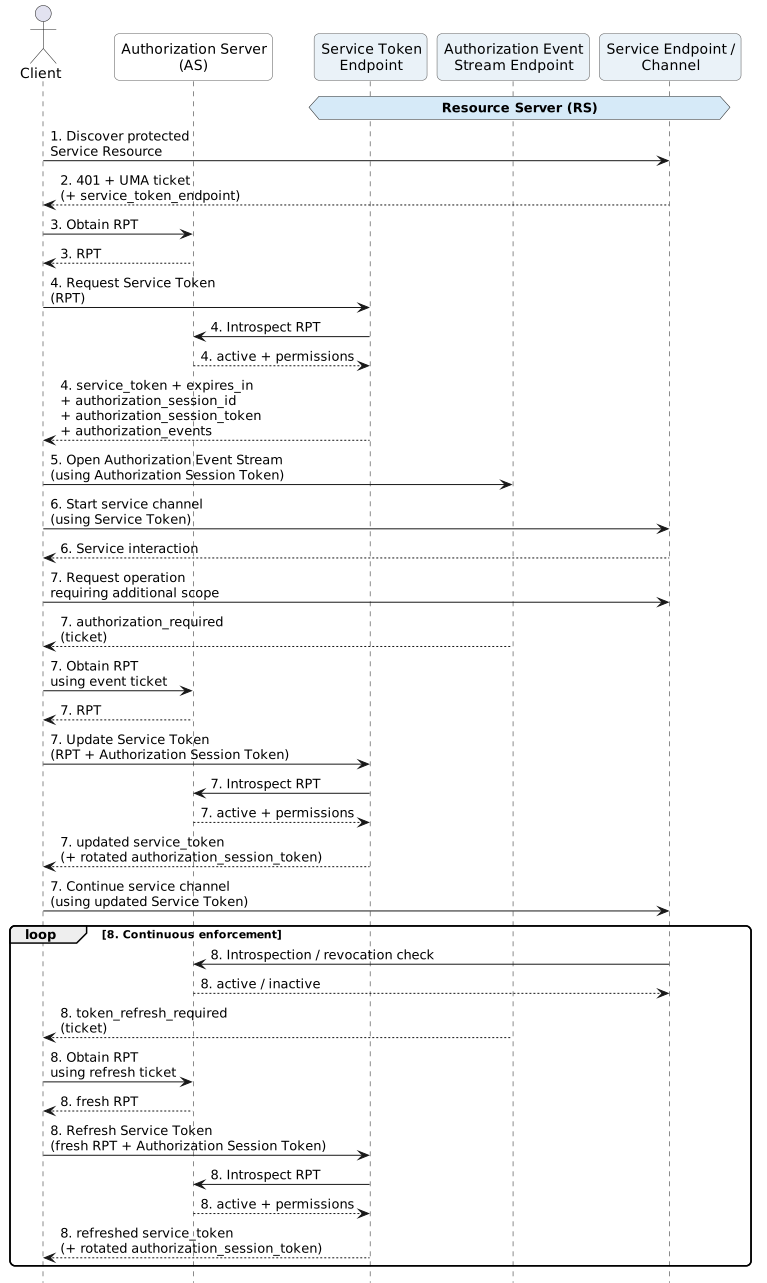
The numbered actions in the diagram correspond to the following steps:
-
Client → RS: The client discovers a protected Service Resource (e.g., by attempting to access it, or by out-of-band discovery depending on the transport).
-
RS → Client: If no valid token is presented, the RS returns
401 Unauthorizedwith an UMA permission ticket and discovery information (e.g., the Authorization Serveras_uriand the Service Token Endpoint). -
Client → AS: The client obtains or refreshes an RPT from the AS using the UMA ticket (UMA details are out of scope for this specification).
-
Client → Service Token Endpoint: The client requests a Service Token by presenting the RPT. The RS introspects the RPT at the AS, derives the Service Resource permissions granted by it, creates an authorization session, and returns a short-lived
service_token, anauthorization_session_id, anauthorization_session_token, and optionally anauthorization_eventsURL. -
Client ↔ RS: The client may connect to the Authorization Event Stream URL using the Authorization Session Token.
-
Client ↔ Service Resource: The client starts (or maintains) the service channel, presenting the
service_tokenusing transport-specific mechanisms. -
Client ↔ RS/AS/Service Token Endpoint: If a later service operation requires additional authorization, the RS sends
authorization_requiredon the Authorization Event Stream with a permission ticket. The client obtains a fresh RPT from the AS using that ticket, then calls the Service Token Endpoint with the fresh RPT and the Authorization Session Token. If authorized, the RS returns an updated Service Token representing the complete permission set for the same authorization session and MAY rotate the Authorization Session Token. -
RS ↔ AS/Client/Service Token Endpoint: The RS enforces continuous authorization through expiry, validation, and revocation. If renewal is needed and the Authorization Event Stream is active for the affected session, the RS sends
token_refresh_requiredwith a permission ticket so the client can obtain an RPT if needed and call the Service Token Endpoint. A client can also refresh without the Authorization Event Stream by refreshing the Service Token before theexpires_inlifetime elapses. If authorization fails and cannot be refreshed, the RS terminates the service channel.
The following examples illustrate a complete flow from discovery to starting a service channel, extending the session with an additional scope, and refreshing its authorization.
1. Discovery: Accessing the Service Resource (HTTP-based)
2. Get ticket: RS challenges the client with an UMA permission ticket (+ endpoint discovery)
HTTP / 1.1 401 Unauthorized WWW-Authenticate : UMA as_uri="https://as.example.org", ticket="eyJhbGciOi..." Link : <https://rs.example.org/service/tokens>; rel="https://spec.knows.idlab.ugent.be/service-authorization-for-data-spaces/service-token-endpoint"
2a. Discovery (alternative): Discovering the Service Token Endpoint via well-known configuration
HTTP / 1.1 200 OK Content-Type : application/json { "service_token_endpoint" : "https://rs.example.org/service/tokens" }
3. RPT: Obtaining an RPT from the AS for connection-level access (UMA flow; details depend on UMA deployment)
POST /token HTTP / 1.1 Host : as.example.org Content-Type : application/x-www-form-urlencoded grant_type = urn%3Aietf%3Aparams%3Aoauth%3Agrant-type%3Auma-ticket & ticket = eyJhbGciOi...
HTTP / 1.1 200 OK Content-Type : application/json Cache-Control : no-store { "access_token" : "eyJhbGciOi...<RPT>..." , "token_type" : "Bearer" , "expires_in" : 3600 }
4. Service Token: Exchanging an RPT for a connection-level Service Token
POST /service/tokens HTTP / 1.1 Host : rs.example.org Authorization : Bearer eyJhbGciOi...<RPT>... Content-Type : application/json {}
HTTP / 1.1 200 OK Content-Type : application/json Cache-Control : no-store { "service_token" : "eyJhbGciOi...<service-token>..." , "service_token_format" : "jwt" , "expires_in" : 60 , "authorization_session_id" : "a91e45a2-..." , "authorization_session_token" : "eyJhbGciOi...<authorization-session-token>..." , "authorization_events" : "https://rs.example.org/service/authorization-events/evt-f5d2" }
5. Authorization events: Connecting to the Authorization Event Stream
GET /service/authorization-events/evt-f5d2 HTTP / 1.1 Host : rs.example.org Accept : text/event-stream Authorization : Bearer eyJhbGciOi...<authorization-session-token>...
6. Start service channel: Starting a service channel using the Service Token (WebSocket handshake)
GET /service_1/ws HTTP / 1.1 Host : rs.example.org Upgrade : websocket Connection : Upgrade Sec-WebSocket-Key : dGhlIHNhbXBsZSBub25jZQ== Sec-WebSocket-Version : 13 Authorization : Bearer eyJhbGciOi...<service-token>...
HTTP / 1.1 101 Switching Protocols Upgrade : websocket Connection : Upgrade Sec-WebSocket-Accept : s3pPLMBiTxaQ9kYGzzhZRbK+xOo=
7. Service operation: Requesting an operation that requires an additional scope
The client sends the following transport-specific message over the established service channel:
7a. Additional scope required: RS sends an authorization event when the operation requires more authorization
event: authorization_required
id: evt-7b31
data: {"authorization_session_id":"a91e45a2-...","ticket":"eyJhbGciOi..."}
7b. RPT: Obtaining a fresh RPT using the ticket from the authorization_required event
POST /token HTTP / 1.1 Host : as.example.org Content-Type : application/x-www-form-urlencoded grant_type = urn%3Aietf%3Aparams%3Aoauth%3Agrant-type%3Auma-ticket & ticket = eyJhbGciOi...
HTTP / 1.1 200 OK Content-Type : application/json Cache-Control : no-store { "access_token" : "eyJhbGciOi...<fresh_RPT>..." , "token_type" : "Bearer" , "expires_in" : 3600 }
7c. Service Token (update): Exchanging a fresh RPT for an updated Service Token
POST /service/tokens HTTP / 1.1 Host : rs.example.org Authorization : Bearer eyJhbGciOi...<fresh_RPT>... Content-Type : application/json { "authorization_session_token" : "eyJhbGciOi...<authorization-session-token>..." }
HTTP / 1.1 200 OK Content-Type : application/json Cache-Control : no-store { "service_token" : "eyJhbGciOi...<updated-service-token>..." , "service_token_format" : "jwt" , "expires_in" : 60 , "authorization_session_id" : "a91e45a2-..." , "authorization_session_token" : "eyJhbGciOi...<rotated-authorization-session-token>..." , "authorization_events" : "https://rs.example.org/service/authorization-events/evt-f5d2" }
After receiving the updated Service Token, the client continues the service channel. A transport profile can define when the client needs to present the updated Service Token on an existing channel or re-establish the channel.
8a. Enforcement: RS determines that the authorization associated with the session is no longer active
POST /introspect HTTP / 1.1 Host : as.example.org Authorization : Basic <rs-credentials> Content-Type : application/x-www-form-urlencoded token = eyJhbGciOi...<RPT>...
If introspection returns active: true, the RS continues the session without
sending a refresh event.
8b. Token refresh required: RS signals that the session needs a refreshed Service Token
event: token_refresh_required
id: evt-8c42
data: {"authorization_session_id":"a91e45a2-...","ticket":"eyJhbGciOi...","expires_in":10}
8c. RPT: Obtaining a fresh RPT using the ticket from the token_refresh_required event
POST /token HTTP / 1.1 Host : as.example.org Content-Type : application/x-www-form-urlencoded grant_type = urn%3Aietf%3Aparams%3Aoauth%3Agrant-type%3Auma-ticket & ticket = eyJhbGciOi...
HTTP / 1.1 200 OK Content-Type : application/json Cache-Control : no-store { "access_token" : "eyJhbGciOi...<refreshed_RPT>..." , "token_type" : "Bearer" , "expires_in" : 3600 }
8d. Service Token (refresh): Refreshing the session after token_refresh_required
POST /service/tokens HTTP / 1.1 Host : rs.example.org Authorization : Bearer eyJhbGciOi...<refreshed_RPT>... Content-Type : application/json { "authorization_session_token" : "eyJhbGciOi...<rotated-authorization-session-token>..." }
HTTP / 1.1 200 OK Content-Type : application/json Cache-Control : no-store { "service_token" : "eyJhbGciOi...<refreshed-service-token>..." , "service_token_format" : "jwt" , "expires_in" : 60 , "authorization_session_id" : "a91e45a2-..." , "authorization_session_token" : "eyJhbGciOi...<new-authorization-session-token>..." , "authorization_events" : "https://rs.example.org/service/authorization-events/evt-f5d2" }
7. Token Validation and Lifetimes
The RS MUST validate the RPT before issuing a Service Token. The validation
mechanism is deployment-specific and can include OAuth token introspection with
the AS. When the service_token_format identifies a JWT-based Service Token,
the RS MUST embed an exp claim and a unique jti in each Service Token.
A Service Token’s expiration time MUST NOT be later than the earliest explicit expiration time of the presented RPT or of any authorization state on which the Service Token depends. The RS MUST shorten the Service Token lifetime when necessary to satisfy this requirement.
The RS MAY introspect authorization state during a session or process revocation
notifications from the AS. If the RS determines that the current Service Token
must be refreshed and an Authorization Event Stream is active for the affected
session, the RS MAY send a token_refresh_required event before rejecting
further service operations. The RS MAY also reject further service operations
immediately.
Clients MUST NOT rely on the Authorization Event Stream as the only refresh
trigger. A client can refresh without using the Authorization Event Stream by
obtaining or reusing a valid RPT and calling the Service Token Endpoint with the
RPT in the Authorization header and the Authorization Session Token in the
request body before the current Service Token expires.
The RS MUST terminate the service connection when:
-
the current Service Token is expired and the client has not refreshed it;
-
the AS notifies the RS of revocation;
-
validation indicates that authorization is inactive and the RS determines that refresh is not possible or has not completed in time.
8. Security Considerations
All communications MUST occur over TLS. Tokens SHOULD be proof-of-possession (mTLS or DPoP) bound when the selected transport can carry the required proof. Service Tokens MUST be short-lived, satisfy the expiration bound in § 7 Token Validation and Lifetimes, and be audience-restricted only to the RS.